


Skip to content
Contact us
    Select language

    With renewable diesel demand projections growing stronger, why is the market still so SAF obsessed?

    Published On April 24, 2026
    Written By

    Topsoe

    Last Reviewed On April 24, 2026

    Sure, the headline is a little provocative. And this is certainly not an either-or scenario – SAF is strategically essential, and it will grow fast. But it is still a legitimate question: why do so many new HEFA-based SAF projects awaiting final investment decision underweight or even overlook a renewable diesel/HVO production option in their business plans? asks Milica Folić, Director for Clean Fuels and Chemicals at Topsoe.
     

    Sure, the headline is a little provocative. And this is certainly not an either-or scenario – SAF is strategically essential, and it will grow fast. But it is still a legitimate question: why do so many new HEFA-based SAF projects awaiting final investment decision underweight or even overlook a renewable diesel/HVO production option in their business plans? asks Milica Folić, Director for Clean Fuels and Chemicals at Topsoe. 

    Consider the fundamentals. Demand signals for HVO have strengthened across the EU and US, backed by new developments in regulatory drivers. The ability to switch between SAF and HVO production delivers operational flexibility and de-risks demand exposure. Renewable diesel can serve as a first step into renewable fuels building feedstock supply chains, operating experience and cashflow before advancing to SAF production. Yet in the rush to deliver aviation’s cleaner fuel future, many projects have treated HVO as an afterthought rather than a practical lever to get to FID. 

    Demand for HVO is showing solid growth 

    In both the US and EU, decarbonization incentivization and goals in areas such as road transportation create broad, liquid demand. This means more potential buyers, simpler contracting and faster monetization. For producers, that matters as a project can be financeable even without a single large offtaker if there is a deep, active market and clear eligibility rules. That market structure is one reason renewable diesel often becomes the first renewable product for refiners converting assets, or for new entrants. 

    A recent Argus Biofuels Analytics report forecasts an 11% year-on-year jump in EU biofuels demand to 34.2 billion litres (34.2 million m³ or 9.03 billion US gallons) in 2026, driven largely by a 2.5 billion litre (2.5 million m³ or 660 million US gallons) increase in HVO led by Germany. SAF demand grows faster in percentage terms at 19%, but from a smaller base. European HVO and SAF production capacity is expected to balance demand through 2027, then tip into deficit from 2028 as RED III transpositions and SAF obligations tighten.  

    By 2030, Argus projects a supply shortfall exceeding 12 million tonnes. Waste lipid competition intensifies across this timeline, with structural tightening of hydro-treatable advanced feedstocks emerging by 2028. The combination – near-term HVO pull and mid-term structural supply tightening – makes sequencing and optionality more than theoretical advantages. In other words: HVO can be a near-term opportunity. And because feedstocks and compliance tighten, the winners will be the ones who design for flexibility and bankability. 

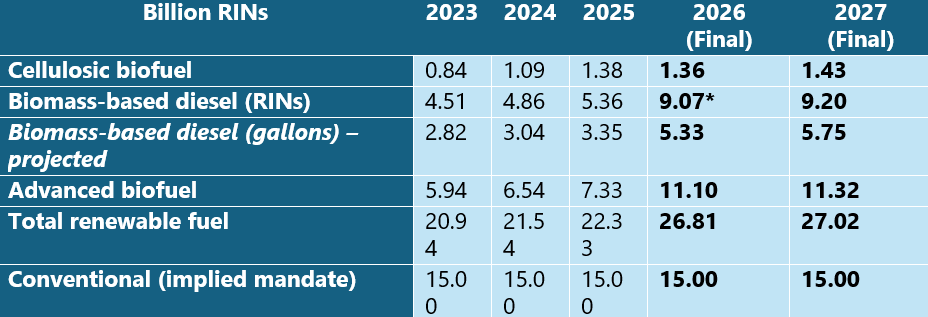
    A similar dynamic is taking shape in the US under the Renewable Fuel Standard. The Environmental Protection Agency (EPA) has finalized the Renewable Volume Obligations (RVOs) for biomass-based diesel for 2026 and 2027. The final rule, announced on 27 March, 2026, sets total applicable volumes at 9.07 billion RINs in 2026 and 9.20 billion RINs in 2027, inclusive of a 70% reallocation of small refinery exemptions (SREs) granted for 2023–2025. These RIN-based volumes are expressed in ethanol-equivalent gallons and are not directly comparable to prior physical-gallon requirements; however, the EPA has confirmed that the finalized volumes guarantee at least 5.33 billion gallons of biomass-based diesel in 2026 and 5.75 billion gallons in 2027. The obligation applies to both renewable diesel and biodiesel, and the compliance bar has been raised relative to base-only volumes due to the inclusion of SRE reallocation in the applicable totals (see table). 

    With the rule now finalized, the prior uncertainty around volume levels has been resolved. The confirmed gallon-equivalent floors of 5.33 billion gallons (2026) and 5.75 billion gallons (2027) represent meaningful year-on-year growth and are broadly in line with the lower end of earlier market expectations. Importantly, fuels must be produced in the US to capture full value, which continues to underpin the investment case for domestic renewable diesel capacity. The finalized percentage standards for biomass-based diesel (D4 RINs) are 5.24% for 2026 and 5.37% for 2027, which are the operative figures that obligated parties apply to their gasoline and diesel production or import volumes to calculate their annual compliance obligations. 

    Final Volume Requirements 

    table
    *The BBD RIN jump from 5.36 to 9.07 is large because the EPA shifted from a physical-gallon basis to a RIN basis for BBD starting with the Set Two rule.

    So why does SAF dominate when HVO looks easier? 

    SAF is governed by the ASTM D7566 specification, while HVO is covered by the EN 15940 standard in Europe and ASTM D975 in the US. These standards define product requirements such as density, viscosity and cold-flow properties tailored to each end use. From a processing perspective, SAF requires a slightly lighter product slate, which typically necessitates an additional hydrocracking step for the fraction of product not already in the SAF boiling range.  

    An alternative approach is to co-produce HVO and SAF simultaneously, but this limits the ability to operate in a maximum or ‘pure’ SAF production mode. Incorporating hydrocracking provides that flexibility. This is because when only producing renewable diesel – or diesel and some SAF (<50%) – the hydrocracker can be bypassed; when SAF demand or pricing strengthens, it can be brought into service to shift product yield toward maximum jet fuel.  

    With some justification, SAF has become the symbol of hard-to-abate decarbonization. It’s consumer and end-user relatable. And it’s where mandates are also rising. As a result, it captures attention and headlines. For many companies, SAF ambitions signal transformation in a way renewable diesel maybe doesn’t. But headlines don’t always equal FID. When you map projects against what attracts finance (secure feedstock, proven configuration, clear incentives, de-risked environment, meaningful offtake agreements, etc.) renewable diesel/HVO can offer a faster, lower-friction, supplementary route.  

    This is not about choosing HVO over SAF, it’s about sequencing and risk. For many projects, the best risk-adjusted strategy is choosing optionality. Configurations that can change between renewable diesel and SAF can react to where value is highest and preserve upside by capturing SAF premiums as mandates tighten and infrastructure matures. 

    Optionality is a practical step and needs to be integrated in unit configuration, catalyst choices, fractionation and isomerization strategy and logistics. The goal for producers should be to make the commercial plan resilient: if SAF offtake lags, the plant still runs producing HVO and if SAF value spikes, you can capture it without a redesign. 

    Action plan: a roadmap for refiners and new entrants 

    The right first step depends on your constraints: feedstock position, hydrogen availability and carbon intensity, market access (road vs airport), risk appetite, and policy jurisdiction. For some, SAF-first is rational, especially with anchored offtake and clear mandate pull. For many, renewable diesel-first (with SAF-ready design) is the faster route to a financeable project. 

    A disciplined prioritization process can convert the debate into a plan: screen routes, quantify sensitivities, select a configuration that preserves options, and build the contracting strategy early. The goal is not to pick the most fashionable molecule. It is to build a profitable, scalable platform that can evolve as SAF demand strengthens. 

    Translating optionality into a project is a technical choice, but it also requires an in-depth assessment of commercial, regulatory and operational factors. The most effective next step is often to explore scenarios side‑by‑side: renewable diesel‑first, SAF‑first, and flexible configurations that allow product switching as markets and mandates evolve. 

    Topsoe supports this process through structured workshops that bring together feedstock projections, unit configuration options, catalyst and fractionation strategies and hydrogen and carbon intensity considerations. This can help clarify what flexibility means for a given site, and which configurations can preserve value without over‑engineering. 

    Beyond technology, project success depends on alignment with policy frameworks and market access. That includes understanding how regulations, incentives and offtake structures differ across jurisdictions and how they shape the optimal sequencing strategy. With experience across refining, renewables and SAF pathways, Topsoe can help producers turn uncertainty into a clear, financeable roadmap – and one that delivers near‑term returns while keeping options firmly and flexibly open. 

    Contact us

    Want to get to know us better - get in touch!

    Take a deeper look

    cover-temp-720x406

    Our solutions

    Explore our diverse range of proven solutions for transforming renewable resources into fuels and chemicals.

    cover-temp-720x406

    Knowledge and insights

    Stay ahead of the curve by continuously updating your knowledge of the latest energy trends.

    cover-temp-720x406

    Our technologies

    Delve into our different technologies for producing low-carbon and conventional fuels and chemicals as well as for ensuring clean air.

    cover-temp-720x406

    Our podcasts

    Join the conversation on renewable fuels and circular plastic with industry experts and influencers as they discuss emerging trends and best practices.

    cover-temp-720x406

    About us

    We were founded by Dr. Haldor Topsøe in 1940. Today, we are a leading global provider of technology and solutions for the energy transition.

    cta-icon-1

    Get the latest

    Keep up with the latest news and inside stories from Topsoe.

    cta-icon-2

    Join our team

    We turn challenges into opportunities. Sound like something for you? Explore our current vacancies here.

    Topsoe_People_Pictures_-_Frederiksund_Outdoor_9_1