Skip to content
Contact us
    Select language

    A significant breakthrough in LNMO battery cycle life

    Published On 31 August 2026
    Written By

    Topsoe

    Last Reviewed On 31 August 2026
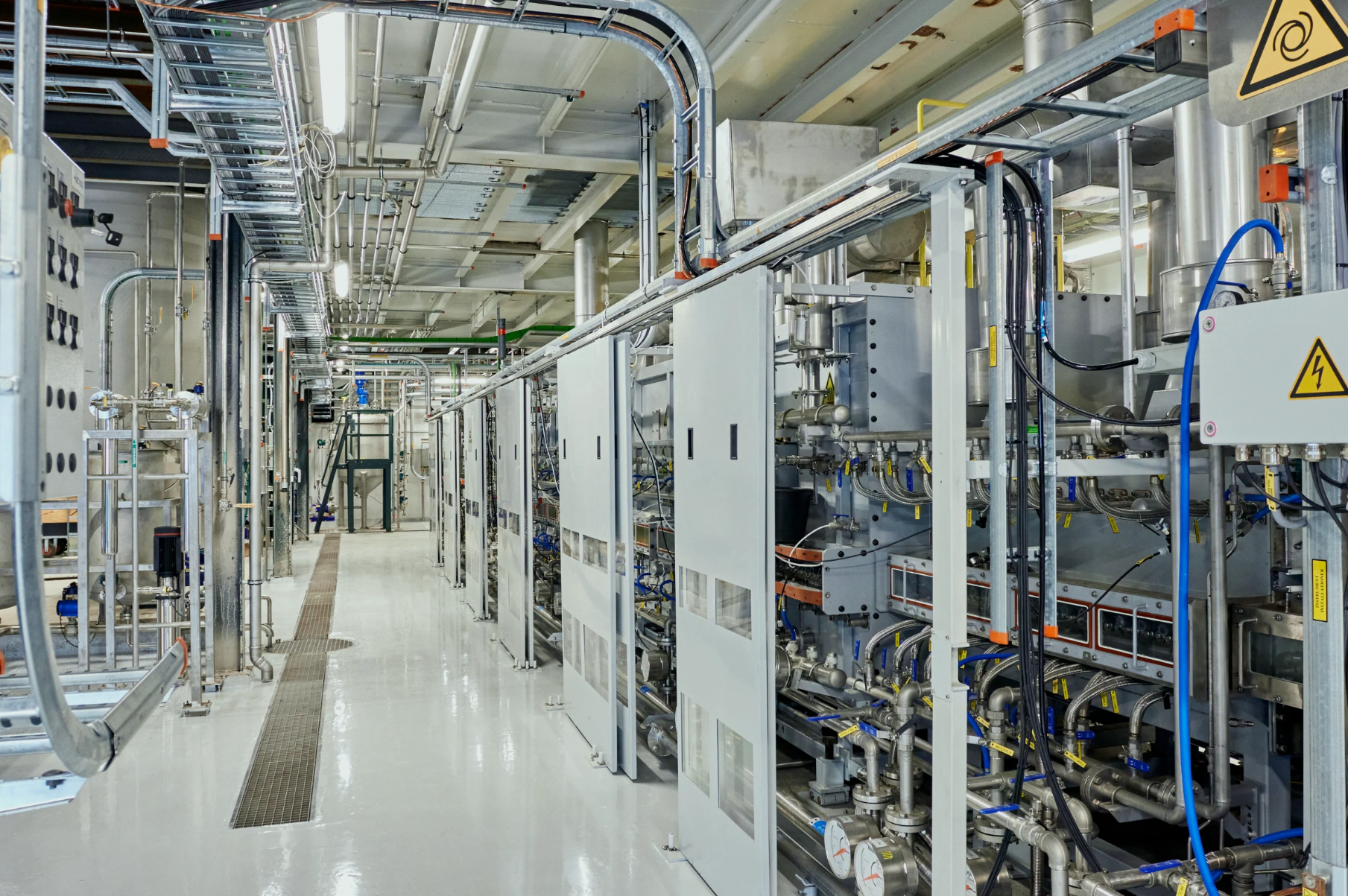
    Battery materials plant

    At Topsoe, we have achieved a major breakthrough in next-generation battery technology, demonstrating 1500 charge-discharge cycles with 80% capacity retention in LNMO-graphite battery cells. Cycling data is shown in Figure 1. This represents a 3-5x improvement over conventional LNMO performance and meets the demanding durability requirements for automotive electric vehicle applications. 

    A significant breakthrough in LNMO battery cycle life

    At Topsoe, we have achieved a major breakthrough in next-generation battery technology, demonstrating 1500 charge-discharge cycles with 80% capacity retention in LNMO-graphite battery cells. Cycling data is shown in Figure 1. This represents a 3-5x improvement over conventional LNMO performance and meets the demanding durability requirements for automotive electric vehicle applications.

    This milestone removes a critical barrier to the widespread adoption of LNMO (lithium nickel manganese oxide) cathode materials, bringing cobalt-free, high-performance batteries closer to commercial reality.

    Figure 1 (2)
    Figure 1: Multilayer pouch cell (1 Ah) cycled at 25°C. Cathode: Topsoe LNMO Gen3 (2.5 mAh/cm2/side). Anode: artificial graphite (N/P=1.2). Electrolyte: 1 M LiPF6 in EC:EMC (3:7) + additives. Cycled between 4.0 V and 4.75 V with 0.5C charge and 1C discharge.

    Why LNMO matters

    LNMO cathode materials offer a compelling value proposition for the battery industry:

    Price-Performance ratio: With energy density close to NMC at a cost of LFP

    Low cost: Rich in cheap and abundant manganese, cobalt-free, and full utilization of lithium

    High working potential: Delivering energy density comparable to high-nickel cathodes  

    Environmental benefits: More sustainable sourcing and production

    Unfortunately, most LNMO batteries have historically suffered from poor cycle life, typically achieving only 250-500 cycles at 25°C before reaching 80% of initial capacity. This has prevented them from competing with established cathode chemistries in demanding applications like electric vehicles, which typically require 1000-1500 cycles.

    The challenge: Why LNMO batteries degrade

    The root cause of poor LNMO cycle life lies in the very feature that makes it attractive: its high operating voltage. At 5V, LNMO batteries experience accelerated degradation through several interconnected mechanisms:

    Electrolyte breakdown and chemical crosstalk

    The high voltage causes conventional electrolytes to degrade at the cathode surface. This triggers a cascade of problems:

    HF is formed in the electrolyte             

    Manganese dissolves from the cathode into the electrolyte

    Dissolved manganese migrates to the anode and damages the SEI layer

    Continued growth of the SEI layer leads to loss of lithium and capacity fade

    This phenomenon, where degradation products from one electrode affect the other, is called chemical crosstalk.

    Electrode imbalance and lithium plating

    A second challenge comes from a phenomenon known as ‘non-chemical crosstalk’ that relates to electrode balancing and voltage window. When the voltage window and electrode capacity ratios aren't optimized for LNMO's unique characteristics, the anode can be pushed into extreme states that will either cause lithium plating, with metallic lithium deposits forming on the anode surface instead of intercalating properly into the graphite, or lead to decomposition of SEI layer. Lithium plating is particularly dangerous because it creates safety risks (dendrites can pierce the separator) and accelerates further degradation.

    In LNMO systems, these problems compound each other: Manganese dissolution damages the SEI, which makes lithium plating more likely, which causes more degradation, creating a vicious cycle that limits battery life.

    Our solution: A multi-pronged approach

    Solving the LNMO cycle life challenge required addressing both material chemistry and cell-level engineering. Our approach tackles the problem from multiple angles:

    1. Advanced Material Design

    We developed a new generation (Generation 3) of LNMO cathode active material with:

    Improved oxidation stability: The material better resists high-voltage stress, reducing electrolyte degradation

    Reduced manganese dissolution: Minimizing the chemical crosstalk that damages the anode

    Better surface stability: Our Gen3 material shows much less self-discharge compared to Gen2, indicating superior stability

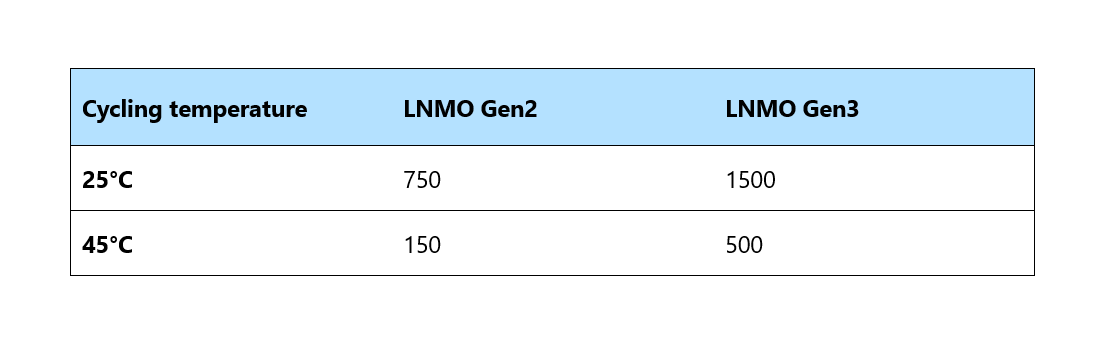
    As shown in Table 1, these improvements have significantly increased cycle life at both 25°C and 45°C compared to Generation 2.

    Table 1
    Table 1: Number of cycles to reach 80% of initial capacity at 25°C and 45°C. Measurements are performed using multilayer pouch cells (1 Ah). Cathode: Topsoe LNMO Gen2 and Gen3, respectively, (2.5 mAh/cm2/side). Anode: artificial graphite (N/P=1.2). Electrolyte: 1 M LiPF6 in EC:EMC (3:7) + additives. Cycled between 4.0 V and 4.75 V with 0.5C charge and 1C discharge.

    2. Optimized Voltage Window

    LNMO requires slightly different operating parameters than conventional battery chemistries. Through detailed electrochemical analysis using 3-electrode measurement techniques, we identified the optimal voltage window:

    Lower cut-off: To keep the anode in a safe operating range even as the battery ages, 4.0V is preferred compared to 3.5V, which is often used

    Upper cut-off: To prevent the anode from reaching potentials where lithium plating occurs during charging, 4.75V is preferred compared to 4.8V and 4.9V, which is often used

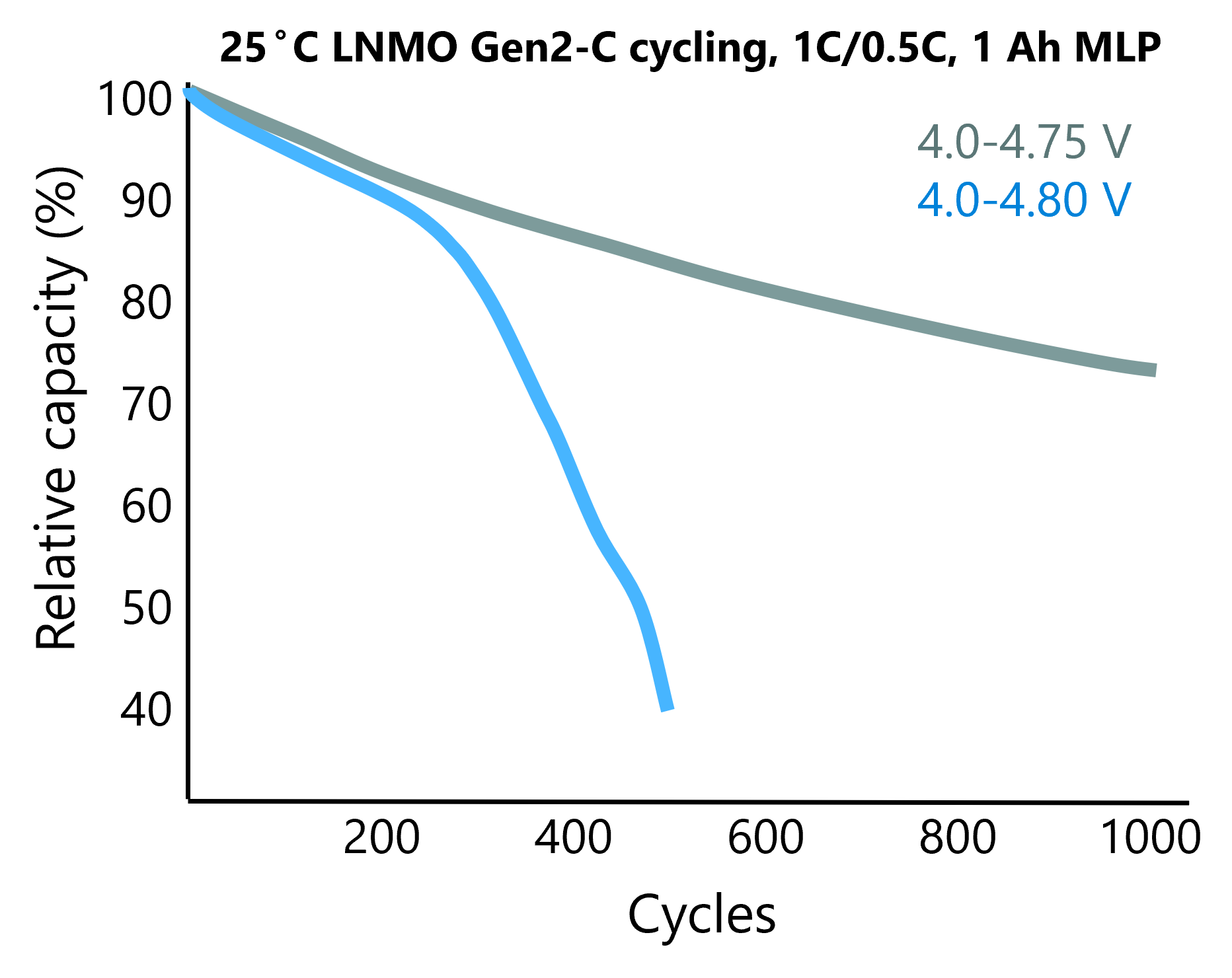
    These might seem like small adjustments, but they make a dramatic difference. Cycling data with LNMO Gen2 as cathode material comparing upper cut-off of 4.75 V with 4.80 V is shown in Figure 2. It is seen that cycling is significantly better with upper cut-off of 4.75 V. Postmortem analysis confirms plating in the cell using upper cut-off of 4.80 V and that using 4.75 V completely eliminates lithium plating.

    Figure 2_update_battery materials
    Figure 2: Multilayer pouch cells (1 Ah) cycled at 25°C. Cathode: Topsoe LNMO Gen2 (2.5 mAh/cm2/side). Anode: artificial graphite (N/P=1.2). Electrolyte: 1 M LiPF6 in EC:EMC (3:7) + additives. Cycled between 4.0 V and 4.75 V and 4.80 V, respectively, with 0.5C charge and 1C discharge.

    3. Electrolyte Compatibility

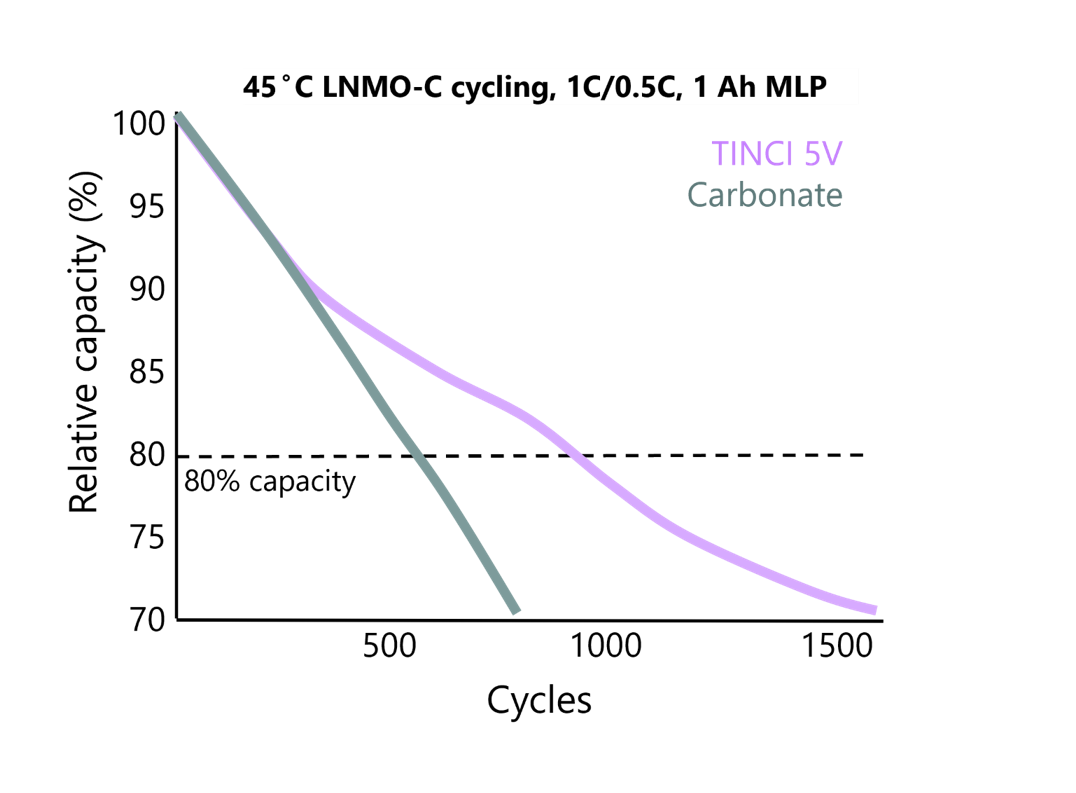
    Working with industry partners, we validate that our LNMO materials perform reliably with commercially available electrolytes. The data presented in Figures 1 and 2 are based on ordinary carbonate-based electrolytes that, in addition to stable cycling, show no gas evolution at room temperature, a key indicator of electrochemical stability. In parallel we are exploring electrolyte chemistries beyond the conventional chemical space, which show promise for further improving high-temperature performance. Partnering with Guangzhou Tinci Materials Technology Co., Ltd. (TINCI), we demonstrated that their 5V electrolyte significantly enhanced cycle life of LNMO-graphite cells at 45°C, reaching 80% of initial capacity after 900 cycles and 70% of initial capacity after more than 1600 cycles, while also reducing gas generation. This is almost a doubling of cycle life compared to ordinary carbonate-based electrolytes. The cycling data is shown in Figure 3.

    Figure 3
    Figure 3: Multilayer pouch cell (1 Ah) cycled at 45°C. Cathode: Topsoe LNMO Gen3 (2.5 mAh/cm2/side). Anode: artificial graphite (N/P=1.2). Electrolyte: 5V electrolyte from Guangzhou Tinci Materials Technology Co., Ltd. (TINCI) and 1 M LiPF6 in EC:EMC (3:7) + additives (Carbonate). Cycled between 4.0 V and 4.75 V with 0.5C charge and 1C discharge.

    The Result: Automotive-grade charge-discharge cycle performance

    At our R&D facilities, we validate our materials through rigorous testing using multilayer pouch cells (~1 Ah) that closely mirror real-world battery configurations. Here, we have achieved over 1500 charge-discharge cycles with 80% capacity retention in LNMO-graphite full cells. This exceeds the durability requirements for automotive electric vehicle applications and represents a 3-5x improvement over conventional LNMO performance reported in the literature. Postmortem analysis of our optimized cells shows no lithium plating and minimal electrode degradation, confirming that our integrated approach successfully addresses the fundamental degradation mechanisms.

    What this means

    As global demand for batteries continues to surge, driven by electric vehicles, grid storage, and electrification across industries, innovations like high-performance LNMO cathodes will be essential to building a sustainable, scalable, and affordable battery ecosystem. Our battery cycle life achievement demonstrates that with the right combination of material science and electrochemical engineering, the promise of cobalt-free, high-voltage cathode materials can become reality, enabling the next generation of energy storage technology.

    Learn more about our LNMO cathode active materials -> Battery Materials | LNMO Cathode Active Material (CAM) | Topsoe 

    Download our white paper on non-chemical crosstalk -> engage.topsoe.com/y1050501389 

    Contact Us

    Want to get to know us better - get in touch!

    Take a deeper look

    cover-temp-720x406

    Our solutions

    Explore our diverse range of proven solutions for transforming renewable resources into fuels and chemicals.

    cover-temp-720x406

    Knowledge and insights

    Stay ahead of the curve by continuously updating your knowledge of the latest energy trends.

    cover-temp-720x406

    Our technologies

    Delve into our different technologies for producing low-carbon and conventional fuels and chemicals as well as for ensuring clean air.

    cover-temp-720x406

    Our podcasts

    Join the conversation on renewable fuels and circular plastic with industry experts and influencers as they discuss emerging trends and best practices.

    cta-icon-1

    Get the latest

    Keep up with the latest news and inside stories from Topsoe.

    cta-icon-2

    Join our team

    We turn challenges into opportunities. Sound like something for you? Explore our current vacancies here.

    Topsoe_People_Pictures_-_Frederiksund_Outdoor_9_1