Skip to content
Contact us
    Select language

    From biogas and biogenic CO₂ to SAF: The FrontFuel demonstration

    1 min read SOEC eREACT™
    Published On 09 June 2026
    Written By

    Topsoe

    Last Reviewed On 09 June 2026

    The FrontFuel demonstration project has established an integrated, end-to-end production pathway for sustainable aviation fuel (SAF) based on industrially sourced biogenic carbon. At the Aarhus University Power-to-X site at Viborg in Foulum, Denmark, the project has connected the full process chain from biogas and biogenic CO₂ through syngas and syncrude to aviation-fuel-range final products.

    Article originally published in the May/June issue of Biofuels International magazine.

    The FrontFuel demonstration project has established an integrated, end-to-end production pathway for sustainable aviation fuel (SAF) based on industrially sourced biogenic carbon. At the Aarhus University Power-to-X site at Viborg in Foulum, Denmark, the project has connected the full process chain from biogas and biogenic CO2 through syngas and syncrude to aviation-fuel-range final products.

    The core achievements are the integration of SOEC hydrogen production, eREACT™-based syngas manufacturing, Sasol LTFT™ based Fischer-Tropsch (FT) synthesis, and downstream upgrading, as well as the demonstration that biogenic carbon can be converted through a continuous, connected process chain into aviation-fuel-relevant hydrocarbons.

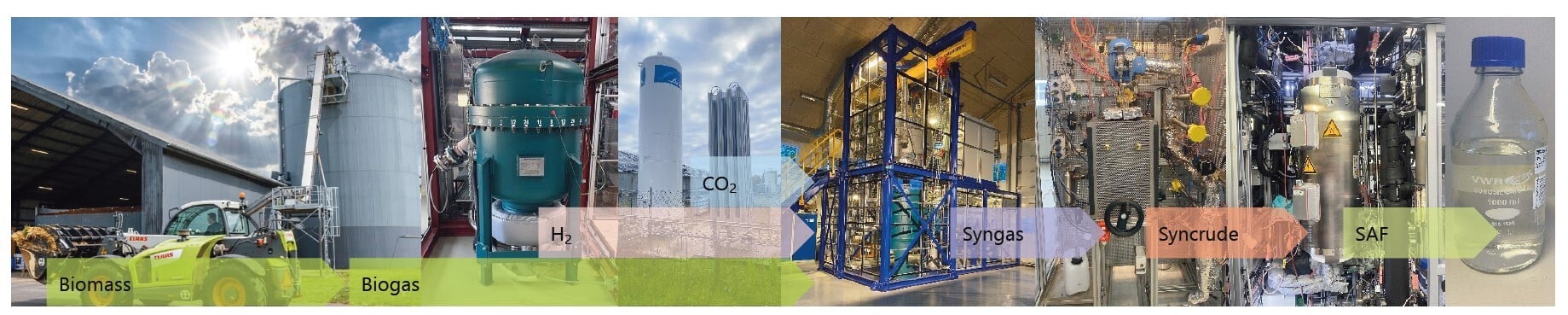
    FrontFuel has progressed from concept validation and component readiness to a true end-to-end process demonstration. The process is summarized in Figure 1. The carbon sources are both sustainable and industrially relevant:

    Biogas derived from agricultural biomass resources such as manure and straw

    Biogenic CO2 captured as a byproduct from fermentation.

    FrontFuel is not only a study of possible process routes. It is a practical demonstration that the full technology chain can be built, integrated and operated on renewable carbon feedstocks in a way that is directly relevant for future plant design.

    Figure 1
    Figure 1: FrontFuel process demonstration chain

    What is FrontFuel and why does feedstock origin matter? 

    FrontFuel is a 45 million DKK (~US$7 million) demonstration project funded in part by the Danish Energy Technology Development and Demonstration Programme (EUDP), which contributed 27 million DKK. The project runs from 2023 to 2026, with Topsoe as project manager, Sasol as key technology partner and Aarhus University as research partner in biogas production and integration in chemicals production.

    The demonstration was assembled in stages between August 2023 and March 2026, with each stage introducing a new unit operation. Beginning from an established biogas reforming configuration, CO2 feedstock supply via cryogenically stored CO2 and the hydrogen integration infrastructure were added. This was followed by the installation of an on-site Fischer-Tropsch (FT) unit, and subsequently integration with an on-site SOEC hydrogen production unit operating at 10 Nm3/h.

    The final stage achieved fully integrated operation, with the SOEC, eREACT, and FT synthesis all running simultaneously, and syncrude collected in batches for subsequent product upgrading. By March 2026, the plant was producing a kerosene-range product synthesized through full integration operating flows included hydrogen at 26 Nm3/h total, CO2 feed at 11 Nm3/h, and biogas at 7 Nm3/h.

    The distinction between a laboratory feedstock simulation and a real carbon source matters for industrial relevance. Both feedstocks used in FrontFuel – biogas from agricultural biomass and biogenic CO2 from fermentation – are industrially available today from established point sources across Europe and globally. Neither are synthetic nor prepared for laboratory conditions.

    The importance of the FrontFuel process package 

    The FrontFuel process configuration connects four steps and addresses one of the central opportunities in SAF production: how to convert different renewable carbon sources into a single, stable synthesis route for hydrocarbon production. Flexible feedstock sourcing, when properly engineered, strengthens the commercial case for large-scale SAF deployment.

    The technology package combines:

    SOEC for hydrogen production;

    eREACT for electrified syngas manufacturing;

    Fischer-Tropsch synthesis for hydrocarbon synthesis;

    Product upgrading toward kerosene-range products.

    Each element contributes to the pathway from renewable carbon to aviation fuel.

    1. SOEC hydrogen production

    Solid oxide electrolysis cells split water into hydrogen and oxygen using electricity. SOEC is the preferred hydrogen production route in the FrontFuel platform because of its energy efficiency, particularly when thermal integration is applied, with heat recovered from the exothermic FT synthesis downstream¹. This thermal integration reduces the net electricity demand of the overall process – a significant factor in the economics of electrified fuel production. The FrontFuel platform is compatible with other electrolysis technologies but for the above reasons SOEC is the preferred configuration.

    2. eREACT electrified syngas manufacturing

    eREACT is the front-end integrator. Its function is to convert variable renewable carbon inputs – ranging from CO2-rich streams to CH4-rich biogas – into a stable synthesis gas with a H2-to-CO (H2/CO) ratio of approximately 2, as required for FT synthesis. The objective is stoichiometric control of the oxygen-to-carbon (O/C) and hydrogen-to-carbon (H/C)2 at the reactor inlet. When CO2 increases in the feed, more hydrogen and less steam are added to maintain target syngas composition; when methane increases in the feed, the adjustment reverses.

    FrontFuel demonstrated this control under dynamic operating conditions, establishing that stable FT hydrocarbon production can be maintained through stable atomic feed rates to the eREACT unit, coupled with integrated feedstock composition control. These results are reported in peer-reviewed research published in the Journal of CO2 Utilization in 2026 by From and colleagues. For industrial plants, eREACT also handles recycling of carbon-containing byproducts from downstream units back into synthesis gas, enabling overall carbon utilization exceeding 95%³.

    3. Fischer-Tropsch synthesis

    FT synthesis converts synthesis gas into paraffinic hydrocarbons. Sasol's low-temperature Fischer-Tropsch process (Sasol LTFT™), used in FrontFuel, employs Sasol's proprietary cobalt-based catalyst in slurry bed reactors optimized for middle distillate yield covering the jet fuel and diesel ranges. Sasol slurry reactors can operate between 300 and 20,000 barrels per day, with several demonstration and commercial reference units spanning this range. For the FrontFuel project, Sasol supplied a small R&D-scale pilot reactor using a continuously stirred tank slurry reactor.

    One point warrants specific attention: SAF certification is tied to the FT synthesis output, not to the plant feedstock or syngas manufacturing method. Feedstock changes upstream of the FT step do not trigger recertification – feedstock flexibility is therefore commercially viable without a new regulatory approval process each time the carbon source changes.

    4. Downstream upgrading

    Topsoe's hydrocracking technology completes the conversion from FT-derived syncrude to kerosene and diesel fractions. For this purpose, two Topsoe-developed catalysts were employed: TK-928 and TK-930. These catalysts are able to convert FT derived material into fuels. The TK-928 catalyst delivers high yields of jet fuel and diesel with good coldflow properties, while TK-930 adds isomerization capability where required. In combination, these catalysts ensure that the upgraded product meets the required specifications for direct use or blending with existing jet fuel and diesel pools. The full upgrading step is Topsoe technology, giving the platform end-to-end technical integration across all four conversion steps.

    The strength of the platform lies in the combination of functions: the front-end manages feedstock variability, while the back-end operates on a uniform syngas basis. That is a powerful plant design principle for large-scale SAF deployment, and it means that Topsoe's existing capabilities within hydrocracking can be utilized directly for the downstream upgrading step.

    Figure 2
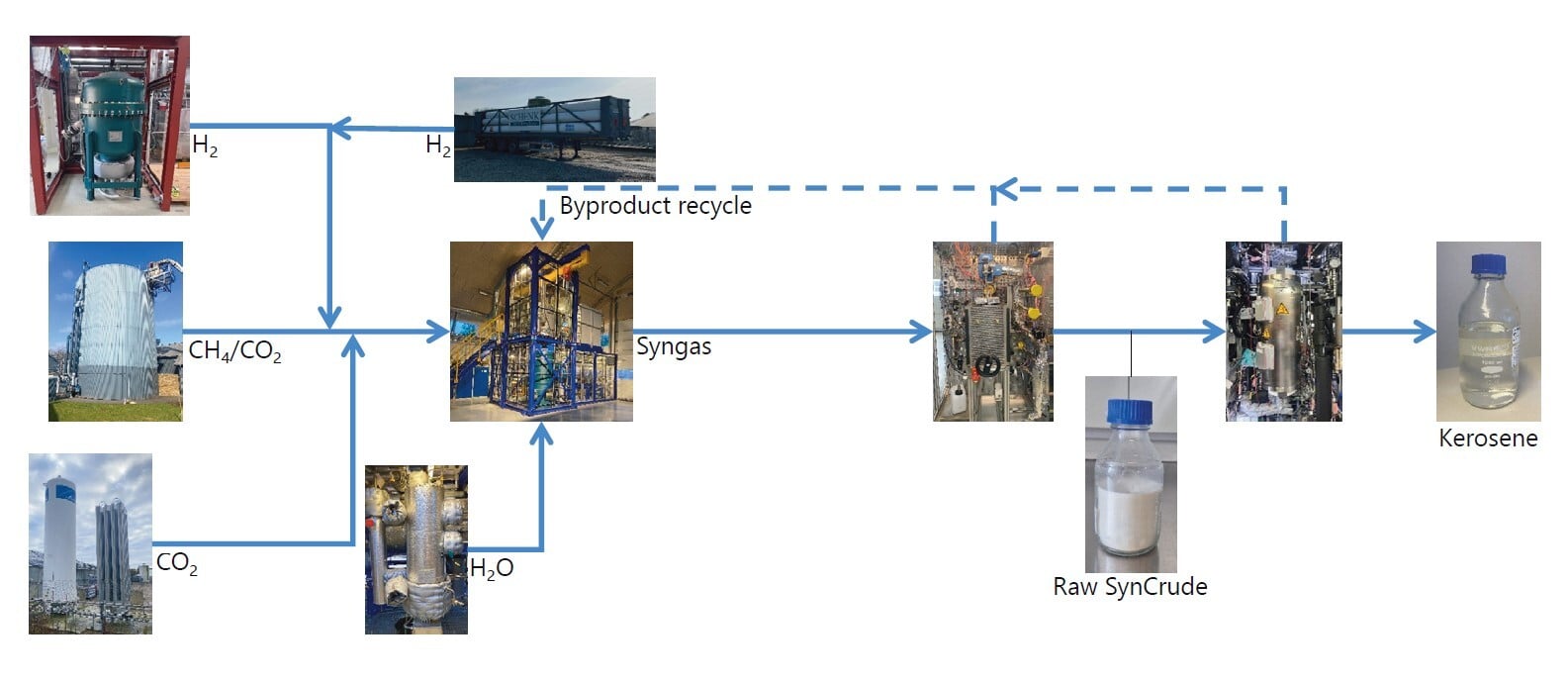
    Figure 2: In-operation process display of the FrontFuel demonstration programme

    Feedstock flexibility as the defining platform feature 

    For FT-based SAF production, the decisive engineering choice is the syngas manufacturing concept. Syngas quality determines carbon utilization, hydrogen demand, downstream synthesis stability and the overall energy efficiency of the plant.

    A key operational finding from FrontFuel is that feedstock flexibility does not have to come at the expense of process stability. Different renewable carbon feeds contain different atomic balances of carbon, hydrogen and oxygen. FrontFuel shows that this variation can be managed by controlling the O/C and H/C ratios in the syngas manufacturing step, allowing the process to move between CO₂-rich and CH₄-rich feeds while maintaining syngas composition suitable for FT synthesis.

    The project demonstrated the production of stable syngas quality across different carbon sources, including online variation between biogas and CO2, while maintaining constant product gas flow and steady syncrude production. For plant design, this means the plant does not have to be optimized around one single carbon source if the syngas platform is deigned correctly. Designing for feedstock flexibility and operating on different feedstocks and mixtures of these provide a solid business case for the customer.

    The implications differ by feedstock:

    CO2-based routes are highly scalable and strategically attractive because oxidized carbon can be directly valorized when sufficient renewable hydrogen is available. However, this route is more hydrogen- and consequently electricity-intensive, making it strongly dependent on access to stable supply and low-cost renewable power and efficient electrolysis integration.

    Biogas is particularly attractive because it is biogenic and contains both CH4 and CO2 – naturally providing a more balanced stoichiometric starting point than pure CO2. This reduces hydrogen demand relative to a fully CO2-based route. FrontFuel demonstrated that biogas can be used directly in an integrated fuel production scheme with stable syngas generation and syncrude production maintained through front-end stoichiometry control.

    Biomethane and methane-rich feeds are well suited for reforming and can be converted efficiently in an electrified front-end. As methane becomes the dominant carbon source, the future front-end layout may shift toward hybrid eREACT-plus-ATR or ATR-based concepts. The broader Topsoe toolbox – including SynCOR™ for oxygen-based syngas generation – becomes relevant here, while downstream FT and upgrading remain largely unchanged.

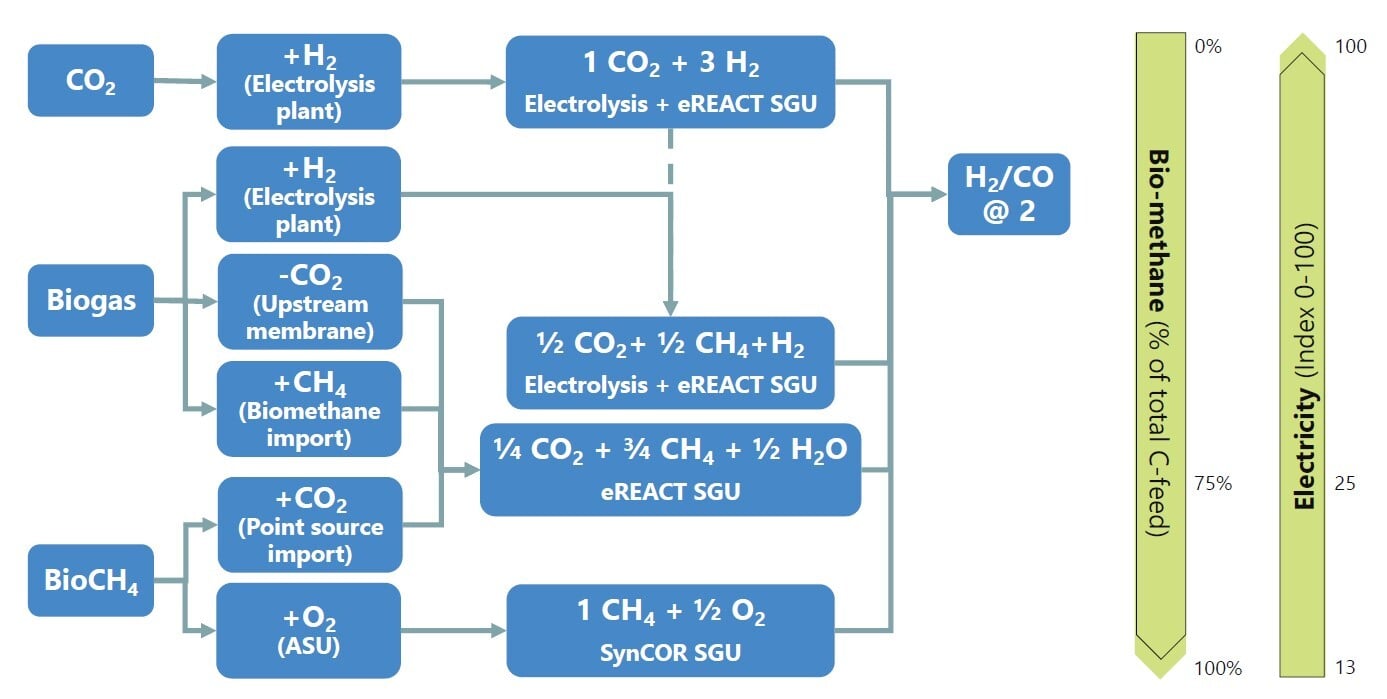
    This feedstock choice matrix is captured conceptually in Figure 3. The main design principle is simple: more CO2 means higher hydrogen demand and electricity input; more biogas/biomethane gives internal carbon synergy and reduced electricity input. High methane feed fractions gives the lowest electricity input and may shift the preferred front-end configuration.

    Figure 3
    Figure 3: Feedstock integration for variable routes to synthesis gas compliant with Fischer-Tropsch synthesis

    What FrontFuel means for large-scale SAF plant design 

    The FrontFuel results provide a very good stepping stone to large-scale SAF plant design and to demo units like the DLR Technology Platform Power-to-Liquid Fuels (TPP) project. The DLR TPP at Leuna, Germany, is the world's first fully integrated, end-to-end demonstration of e-SAF production based on the G2L™ e-fuels process (Topsoe's eREACT™ and hydroprocessing technology combined with Sasol's LTFT™ (low-temperature Fischer-Tropsch)). Backed by EUR 130 million in funding from the German Federal Ministry for Digital and Transport, the project will operate a 3 MW eREACT unit with Sasol LTFT technology and Topsoe upgrading – the same technology line up as FrontFuel – and is on track for startup in Q4 2027, targeting ~2,500 tons of e-fuels per year, making it the largest e-fuels research and demonstration facility globally.

    The four main principles from FrontFuel that underpin large-scale SAF plant design are:

    1. Renewable hydrogen is the stoichiometric regulator. Hydrogen supply scale and cost are primary inputs to plant design, regardless of which carbon source is selected.

    2. Electrified syngas manufacturing is the flexible carbon integrator. The front-end converts the locally available carbon source into a common synthesis gas intermediate. Front-end configuration should follow from the feedstock composition available at the project site.

    3. The backend operates on a stable syngas basis. Once the front-end is sized and configured for the carbon source, the downstream process design is largely independent of feedstock choice.

    4. The certification pathway is tied to the FT product. Front-end feedstock flexibility does not introduce new regulatory complexity for SAF qualification under the established ASTM pathway.

    The wider eREACT pipeline includes a 3 MW demonstration unit for Aramco (2027), a 15 MW methanol project by NextFuel, and a 45 MW eFuels project by Arcadia – tracing a clear trajectory from the 0.18 MW AU Viborg Foulum pilot to commercial scale.

    Concluding perspective 

    FrontFuel demonstrates that sustainable aviation fuel production does not need to be built around one single carbon source or one rigid plant configuration. It can be based on an electrified technology platform capable of converting multiple forms of sustainable carbon into a common syngas intermediate and onward into renewable fuel.

    The project delivers two outcomes simultaneously: it demonstrates that the SOEC-eREACT-FT technology package is mature enough to serve as a real basis for plant design, and it provides a practical framework for understanding how that design should change as the carbon feed shifts from CO2, to biogas, to methane-rich renewable feeds.

    For project developers assessing SAF opportunities in agricultural regions, the biogas route offers an established carbon source with demonstrated compatibility with the FrontFuel platform. For developers with strong renewable power infrastructure and access to industrial CO2 sources, the CO2 route offers scale without biomass supply constraints. For developers with access to large volumes of sustainable biomethane, hybrid front-end configurations are worth evaluating. Notably, cross-integration between feedstock classes can alleviate plant capacity challenges that arise due to feedstock limitations.

    FrontFuel delivers operating data, peer-reviewed results, and a systematic feedstock choice matrix from a real integrated facility running on genuine biogenic carbon feedstocks. These outputs provide a practical basis for project developers and technology teams evaluating SAF production concepts, particularly those working with locally available carbon sources and site-specific integration constraints.

    This article is reprinted with the kind permission of Biofuels International.

    References

    Hansen, John Bøgild. "Solid oxide electrolysis--a key enabling technology for sustainable energy scenarios." Faraday discussions 182 (2015): 9-48.

    Thomas N. From, Marené Lobban, Victor B. Terkelsen, Jacobus Visagie, Behzad Partoon, Sebastian T. Wismann, Leon Rens Sander Rosseau, Anders Bentien, Peter M. Mortensen, "Interchangeable biogas and CO2 valorization through electrified syngas manufacturing for synthetic fuel production", Journal of CO2 Utilization, Volume 105, 2026, 103331, ISSN 2212-9820.

    Thomas S. Christensen, Kim Aasberg-Pedersen, and Peter M. Mortensen. "eFuels technology for converting CO2 and renewable electricity to renewable synthetic fuels: Topsoe Reverse Water Gas Shift (RWGS) technologies enable production of eFuels and eChemicals from green hydrogen and captured CO2." Topsoe A/S, Renewable synthetic fuels technology, White paper (n.d.). 

    Contact Us

    Want to get to know us better - get in touch!

    Take a deeper look

    cover-temp-720x406

    Our solutions

    Explore our diverse range of proven solutions for transforming renewable resources into fuels and chemicals.

    cover-temp-720x406

    Knowledge and insights

    Stay ahead of the curve by continuously updating your knowledge of the latest energy trends.

    cover-temp-720x406

    Our technologies

    Delve into our different technologies for producing low-carbon and conventional fuels and chemicals as well as for ensuring clean air.

    cover-temp-720x406

    Our podcasts

    Join the conversation on renewable fuels and circular plastic with industry experts and influencers as they discuss emerging trends and best practices.

    cta-icon-1

    Get the latest

    Keep up with the latest news and inside stories from Topsoe.

    cta-icon-2

    Join our team

    We turn challenges into opportunities. Sound like something for you? Explore our current vacancies here.

    Topsoe_People_Pictures_-_Frederiksund_Outdoor_9_1