Recent advancements in AI – from predictive models to generative systems capable of simulating and creating new inputs – have brought AI squarely into the field of molecular modeling and material development. In this article, we speak with Matthias Schwab, Topsoe’s Senior Director of Front-End R&D, about AI’s potential to reshape material innovation and open new frontiers for discovery.
The complex field of material development
Materials are the foundation for every modern technology we interface with and are central to developing decarbonization technologies that are sustainable, cost-competitive, and scalable. Yet material discovery, synthesis, and industrial scaling remain long, iterative processes heavily reliant on trial and error. Schwab describes new material development as “a continuous de-risking exercise” underscoring the scientific rigor required to take materials from lab experimentation to industrial application.
“For example, every new catalyst we make will eventually be applied in industrial-scale plants and refineries” Schwab explains. “Therefore, it is of utmost importance that a new catalyst solution performs reliably from the moment it is first introduced to market. To prepare for this, catalyst development involves performance testing cycles, test productions, extensive analytics, and feedback loops – all of which requires time and significant budget.”
This process is mirrored across all Topsoe’s business areas, from catalysts and process design to electrolysis technologies and batteries. As the pace of the energy transition accelerates, the need to move faster – without compromising quality – has never been greater. “The industry requires us to discover better materials and more efficient compositions at an accelerated rate,” Schwab explains. “To meet the new realities of this market, we believe the application of new tools may now unlock significant potential in processes we have perfected over decades.”
What type of AI systems are relevant in material discovery?
To meet this new reality in the energy industry, Topsoe is exploring a new class of artificial intelligence systems designed for material discovery.
While system designs vary by application, AI systems for material discovery typically share three core properties:
1. They combine predictive and generative AI systems.
2. They are trained to work within the constraints of physics.
3. These systems can synthesize large volumes of visual, mathematical and text-based data.
These three properties in combination distinguish these systems from other models that only focus on one type of data (i.e.: text-based data in large language models) or one way of working with this data (i.e: predictive systems used in classic statistical modelling and trend forecasting). With their use of geometry and the laws of physics, these systems, (also referred to as ‘world models’) are designed to eventually produce outcomes that reflect real-world materiality, generating chemical structures that can actually be tested and validated in a lab.
Exploring a new frontier of potential
The use of these models could open exciting new possibilities for re-inventing material research and design in Topsoe’s business.
“Topsoe has long leveraged its strong scientific heritage to develop latest-generation solutions for the industry, but we have done it in the traditional way. The discovery of new materials depends on scientific rigor, but in a material world with unlimited possibilities of molecular compositions, this rigor is also balanced with serendipity, intuition and trial-and-error.”
- Matthias Schwab, Senior Director of Front-End R&D
Artificial Intelligence, Shwab believes, could fundamentally change this balance. “AI for Materials is not just a new category of technology; it could be a new methodology. Within a material discovery journey, there are numerous trade-offs that must be made. What materials do we have the capacity to consider? How many experiments can we carry out? AI may allow us to screen a much larger experimental space, and if the underlying data is of high quality, unexpected discoveries could be made.”
This potential has already triggered a wave of innovation across the industry. In 2024, Meta and VSParticle launched the first ever and largest open-source catalyst database, which within the first few months resulted in 525 new materials being synthesized. While large computational material databases have existed for years (other examples include The Materials Project, NOMAD, Alexandria and The Computational Materials Repository just to name a few), this wealth of information has only recently been met with systems that have the computational design to reason with and create from this data. With over 85 years of documented scientific exploration, Schwab describes Topsoe’s knowledge and research as a “great treasure” that advanced AI may finally be able to unlock.
Understanding the boundaries of AI in material science
While the integration of generative AI may signal a new age in material discovery, we are still in the beginning of this transition, and having a grounded understanding of AI’s capacities and limitations is essential in using these systems effectively and responsibly. Among the more common limitations, here are a few to consider:
1. Availability of quality data and data ownership
An AI system is only as good as the quality of its data set. While the increasing availability of open-sourced data paired with customer-specific proprietary knowledge is a powerful combination, optimal results require decades of knowledge stored in databases that meet FAIR principles (Findability, Accessibility, Interoperability and Reusability). Many scientific fields, including chemical engineering, have historically fallen short of these digital standards, and while there are impressive measures being taken to address this (i.e.: The European Materials and Modelling Ontology) the quality of our data will have to reflect our high aspirations before AI systems can help in realizing them.
“Additionally, high-quality data related to product development is often kept within confidential archives,” Schwab adds. “Many companies working within science and technology, including Topsoe, store years of proprietary information and protect it accordingly. It is yet to be defined how and if such proprietary data can be used to fuel machine learning loops, and how to reset these loops when a task is completed to avoid information spillover and breaches in confidentiality.”
2. Bias in machine learning and data typology
Any AI system trained on a data set will take on the fundamental limitations of these data sets. This is not a problem if these limitations are intentional, but if these limitations are unintended in the research and affect the AI’s ability to deliver varied and truly innovative outcomes, then the efficacy of the AI system can be compromised. For example, it is just as important to include data from unsuccessful experiments as data from successful ones. Depending on the variety of data sources used, this type of data can easily be missed, as it is commonly found in documents like corporate reporting, but not always included in scientific publications and patents.
3. The irreplaceable role of experiment
In a paper published by Nature Computational Science, M.K. Horton and their co-authors write: “Experiment serves as an anchor to ensure that computation is relevant. Without it, computation is unmoored, forever simulating ever-more-idealized systems.”
AI systems cannot be used as a 1:1 replacement of experimentation, and while integrating them into scientific processes holds immense potential in narrowing down the number of experiments needed and avenues explored, they will never be the sole channel through which these discoveries are made or tested.
Looking ahead
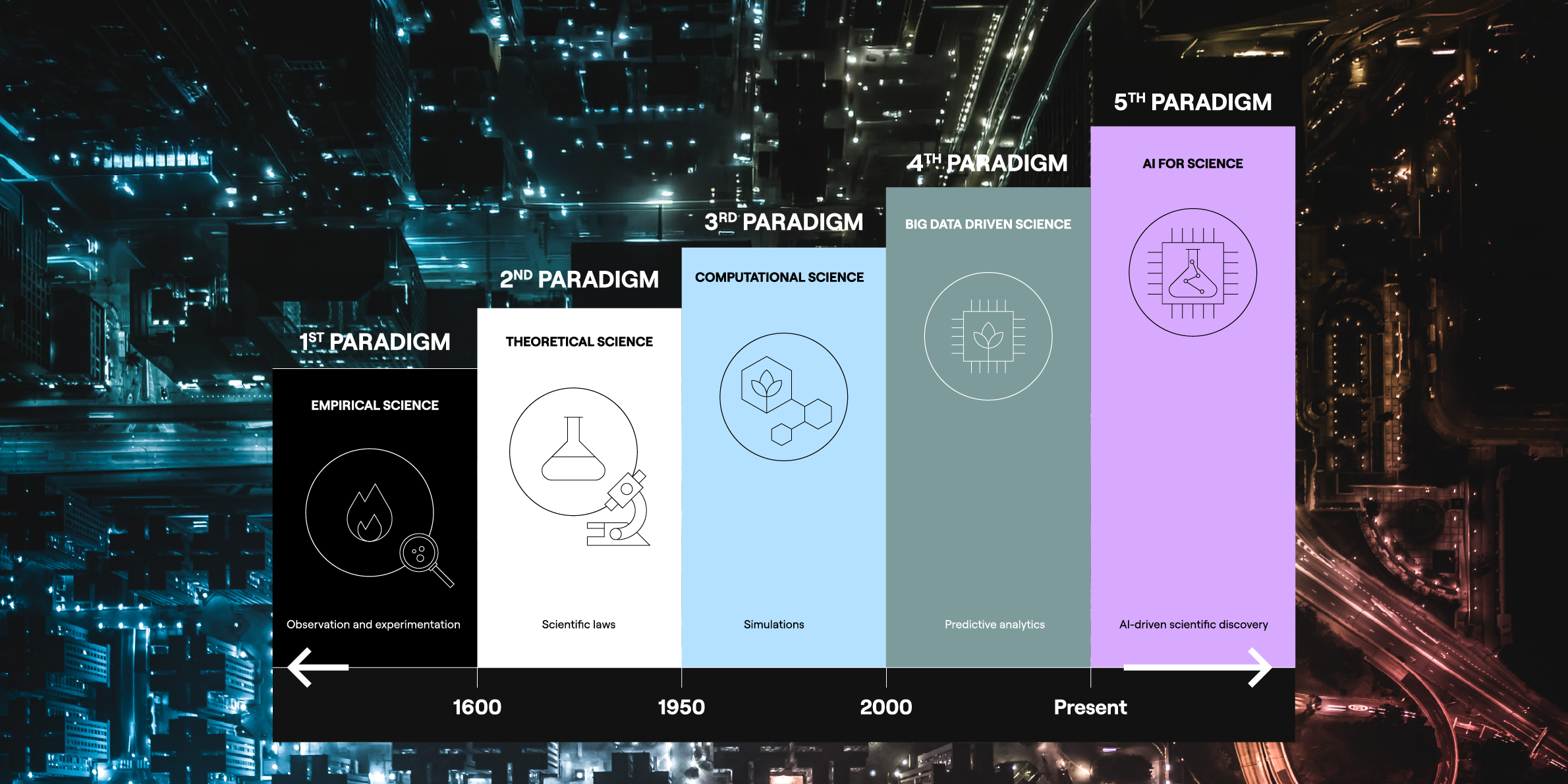
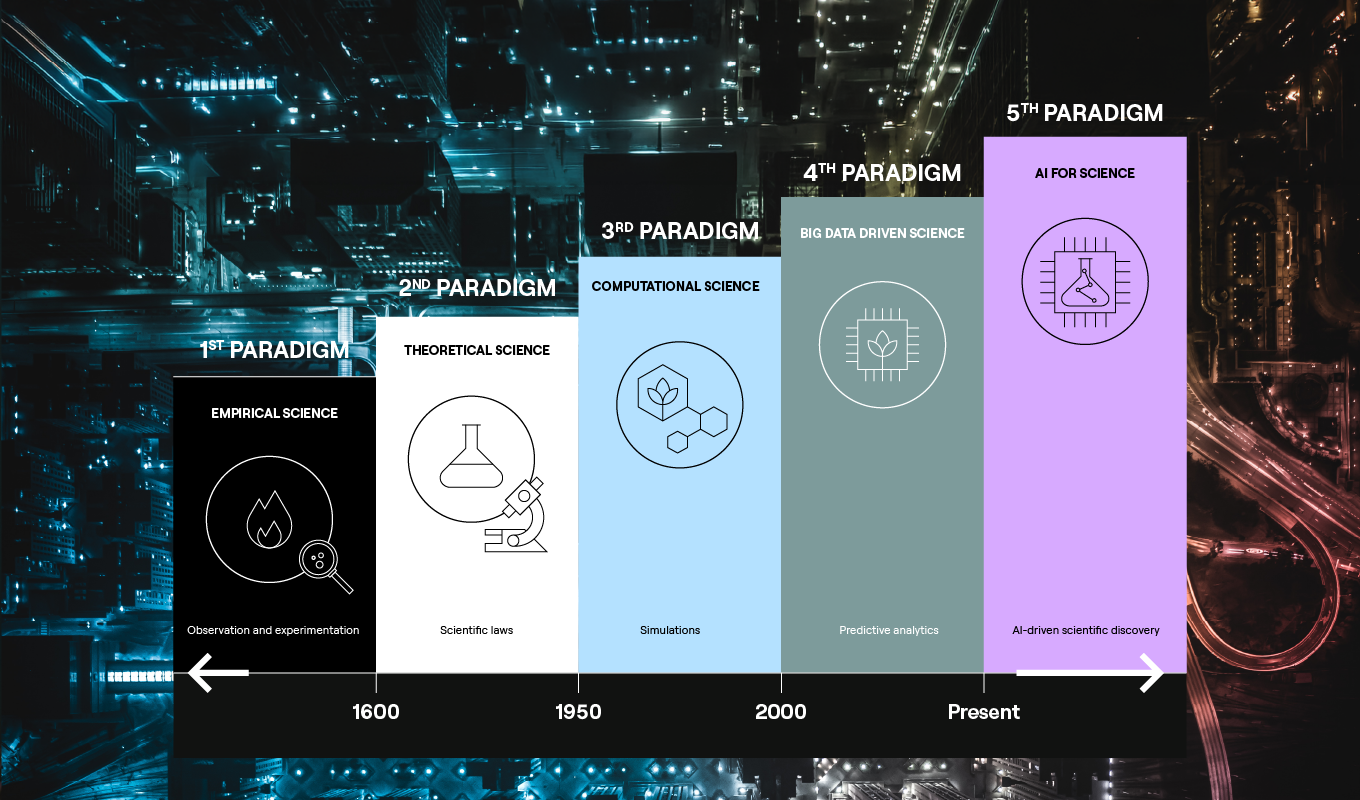
Having existed through multiple paradigm shifts in scientific research, Topsoe is ready and looking ahead into the world of material innovation enabled by AI. “To learn more about this field and gain first-hand experience, we are looking into direct collaborations with academic or industrial partners, as well as joining consortia within public funding initiatives.” Schwab explains. “AI for Materials will require a multi-disciplinary approach, and competency across different fields such as computer science, modelling, advanced analytics, lab automation, and our strong competencies in catalyst development will be essential in creating high quality machine learning.”
Outside of contributing our own knowledge through collaboration, the process to understand the potential of AI in Topsoe’s business is already underway, with Schwab and his colleagues exploring potential use cases across heterogeneous catalysis, electrolysis and batteries. “An AI system bringing even incremental improvements to these materials would have enormous impact on our commercial business and, most importantly, our clients.”
As a science‑driven company, Topsoe approaches AI with both curiosity and critical thinking. Whether AI proves to bring gradual or exponential change, Topsoe is committed to actively shaping its role in the future of material science — rather than waiting on the sidelines.
In the next article of our AI in material science series, we explore the potential application of AI in electrochemical testing with Topsoe’s Head of Technology Scouting & Partnerships, Sune D. Ebbesen, and the AI startup CuspAI.

/Half-year-statement-2026-dropdown-menu-272x204px.jpg)


.png) Topsoe Academy™ Topsoe Academy™ is your chance to tap into over 80 years of accumulated knowledge Find out more
Topsoe Academy™ Topsoe Academy™ is your chance to tap into over 80 years of accumulated knowledge Find out more Why fuel resilience matters for European defense Read
 If you’re ready to work alongside inspiring people like Hadise, Go solve at Topsoe.A place to make an impactRead