

Skip to content
Contact us
    Select language

    Enabling water-based electrode processing with LNMO CAM

    Published On 10 November 2026
    Written By

    Topsoe

    Last Reviewed On 10 November 2026
    water-based electrode processing with LNMO CAM

    At Topsoe, we work every day to provide more sustainable solutions for our customers. A good example of this is our best-in-class Lithium-Nickel-Manganese-Oxide (LNMO) cathode active material (CAM).

    Our LNMO enables water-based, or aqueous, electrode preparation, uses more abundant manganese, is free of cobalt, and has low nickel content compared to NMC. This makes LNMO a long-term and effective method for reducing critical and hazardous materials in your supply chain and for preparing for future tightened regulatory demands, while maintaining high energy density and high performance.

    In this article, we take a closer look at the advantages of aqueous electrode preparation compared to NMP processing of LNMO across performance, cost, and sustainability. 

    No compromise on performance

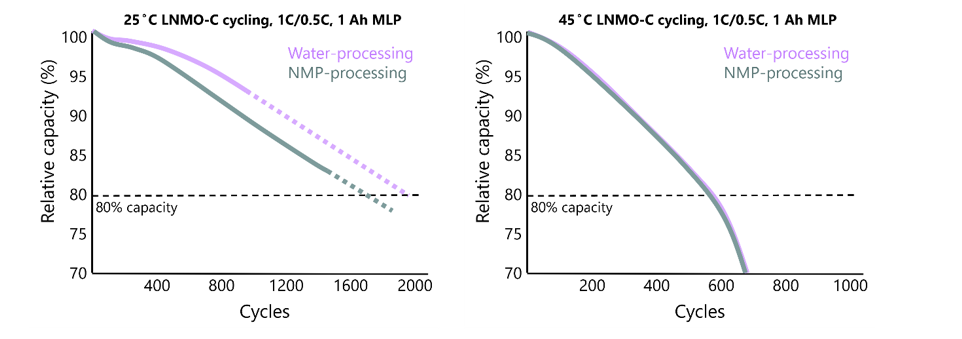
    A common assumption is that switching to water-based processing means sacrificing battery performance. Our data (Figure 1) shows the opposite.

    figur1
    Figure 1. Multi layer pouch cell (1 Ah) cycled at 25°C (left) and 45°C (right). Cathode: Topsoe LNMO Gen3 (2.75 mAh/cm2/side) processed using NMP (grey) and water (purple). Anode: artificial graphite (N/P=1.1). Electrolyte: 1 M LiPF6 in EC:EMC (3:7) + additives. Cycled between 4.0 V and 4.75 V with 0.5C charge and 1C discharge.

    Cells with LNMO cathodes produced using water processing showed capacity retention that matches or exceeds NMP-processed cells at both 25°C and 45°C testing conditions. Water-processed cells demonstrate:

    • Compatibility with cheap conductive and binder systems
    • Low capacity fade and low resistance build-up
    • High coulombic efficiency

    In short: moving to water-based processing doesn't mean compromising on the performance metrics that matter most for battery longevity and reliability.

    A smarter, cheaper way to manufacture

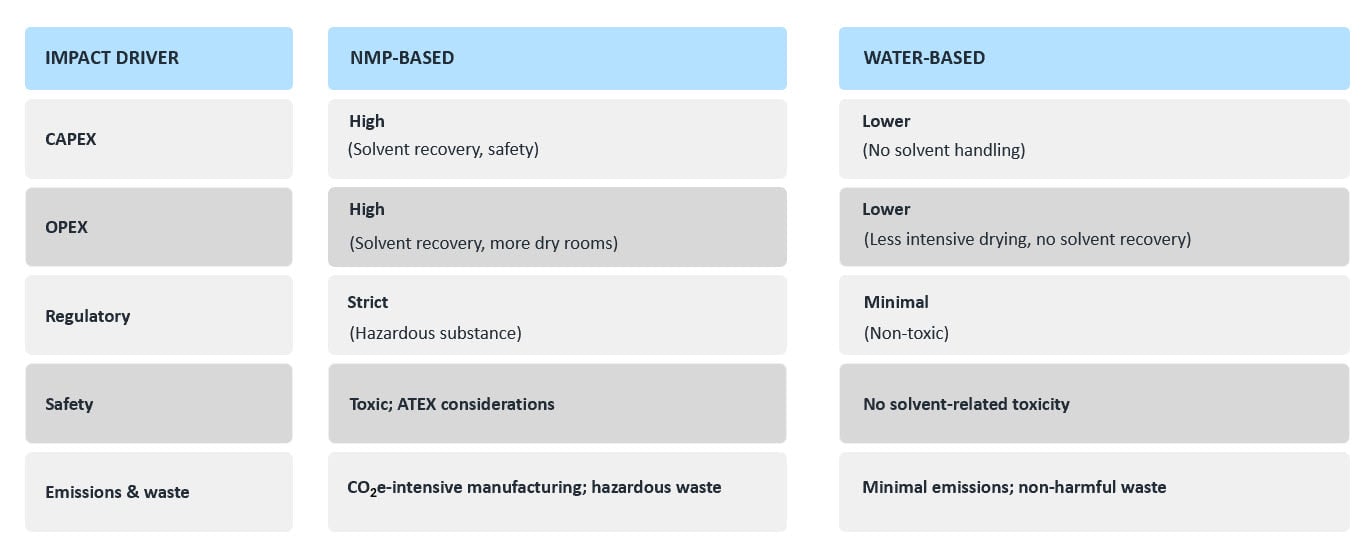
    Beyond matching performance, water-based processing also offers several advantages across the full manufacturing value chain including lower cost. Key impact drivers are summarized in Table 1.

    Battery materials table 1_9 November-1
    Table 1. Comparison of NMP- and water-based processing in electrode manufacturing across key impact drivers.

    We estimate that the levelized cell cost per kWh can be reduced by 2–3% by eliminating solvent-related cost contributions and by using a moisture-tolerant cathode active material.1

    When using NMP to produce electrodes, cell manufacturers are faced with two options: an expensive tolling arrangement with an NMP supplier where recovered NMP is purified externally,1 or an internal energy-intensive solvent recovery system which can recycle nearly all used NMP to high purities with the un-recycled balance being purchased continuously. In both cases, some form of solvent recovery system and NMP purchasing is necessary. Removing NMP from cell manufacturing therefore can provide significant savings on both CAPEX and OPEX. 

    The main CAPEX contribution comes from the elimination of the NMP recovery system – an entire chemical process in its own right – which is required to separate and re-purify used NMP to avoid VOC emissions. In addition to the direct CAPEX savings, OPEX is reduced by avoiding the continuous purchasing of large quantities of costly NMP. Moreover, solvent recovery systems consume massive amounts of energy; NMP recovery systems are reported to account for up to 40 – 50% of the energy consumption associated with Li-ion cell production.2

    Another important contribution comes from the reduction of dry rooms which account for over 40% of cell manufacturing energy consumption.3 The dry room footprint can be substantially lowered when using a moisture-tolerant cathode active material. The cathode coating, calendering, and slitting sections account for approximately 30% of the total dry room footprint;4 an aqueous-compatible cathode eliminates this significant fraction of dry rooms further enabling substantial OPEX and CAPEX savings. The benefits extend beyond cost saving: the risk of moisture contamination during electrode manufacturing is no longer present. When air dryers are strained during hot, humid months, moisture-tolerant LNMO offers a more robust electrode production route. 

    Combining the savings of both CAPEX and OPEX, a realistic overall saving in levelized cell cost per kWh is 2-3%.

    Environment & safety

    Beyond cost and flexibility, moving away from NMP delivers clear environmental and safety benefits. NMP is a severely toxic hazardous substance requiring strict and highly regulated handling, and it introduces real risks that must be mitigated: solvent exposure, fire hazards, explosive hazards during electrode drying, potential VOC emissions, and hazardous waste generation. Water-based processing removes these risks almost entirely: it is non-toxic, inherently safer, and produces minimal emissions and non-harmful waste.

    Besides being safer, aqueous cathode processing is greener too. Considering that it has been reported that 40-50% of energy required for cell manufacturing can be attributed to the NMP evaporation & recovery process,2 it is unsurprising that a switch from NMP to aqueous cathode processing for Li-ion cell manufacturing can reduce the CO2 footprint across the cell value chain by up to 4 – 5%.5 

    This builds on the inherent sustainability advantages of Topsoe's LNMO material itself: little to no wastewater from CAM synthesis, no by-products, and a CO2 footprint on par with LFP and significantly lower than NMC.6

    Conclusion

    Water-based electrode processing, enabled by Topsoe's LNMO cathode material, delivers on:

    • Performance: No penalty, as water-processed cells match or outperform NMP-processed cells over hundreds of cycles

    • Cost: 2-3% lower levelized cell cost per kWh, driven by reduced CAPEX, OPEX, and energy consumption

    • Safety: No toxic and flammable solvents, which enables a safer manufacturing environment

    • Sustainability: Lower emissions due to the removal or reduction of energy intensive processes associated with NMP and moisture-sensitive cathode active materials

    In other words, water-based processing enabled by LNMO is a promising, practical path forward that becomes increasingly attractive as the battery industry faces increasing pressure to reduce costs, improve sustainability, and simplify supply chains.

    Learn more about our LNMO cathode active material 

    References

    1 Knehr, K et al. “Estimated Cost of EV Batteries: 2019-2026.” Argonne National Laboratory. 

    2 Kim, J.-H. et al. ”Kosmotropic aqueous processing solution for green lithium battery cathode manufacturing.” Nature Communications (2025) 16:1686.
    https://doi.org/10.1038/s41467-025-56831-9

    3 Gu, Y. et al. “A cradle-to-grave life-cycle-assessment of dry-processed Li-ion batteries for electric vehicles.” CIRP Annals – Mfg. Tech. 74 (2025) 73 – 76. https://doi.org/10.1016/j.cirp.2025.04.075

    4 Lechner, M. et al. ”Cost modeling for the GWh-scale production of modern lithium-ion battery cells.” Communications Engineering (2024) 3:155.
    https://doi.org/10.1038/s44172-024-00306-0


    5 Voß, P. et al. “Benchmarking state-of-the-art sodium-ion battery cells– modeling energy density and carbon footprint at the gigafactory-scale.” Energy Environ. Sci. 2025, 18, 8104-8129. https://doi.org/10.1039/d5ee00415b

    6
    Own calculations of CO2eq/kg CAM following EU Product Environmental Footprint (PEF) framework for LCA including environmental impacts from materials, transportation, and energy based on Ecoinvent 3.10 database.

    Contact us

    Want to get to know us better - get in touch!

    Take a deeper look

    cover-temp-720x406

    Our solutions

    Explore our diverse range of proven solutions for transforming renewable resources into fuels and chemicals.

    cover-temp-720x406

    Knowledge and insights

    Stay ahead of the curve by continuously updating your knowledge of the latest energy trends.

    cover-temp-720x406

    Our technologies

    Delve into our different technologies for producing low-carbon and conventional fuels and chemicals as well as for ensuring clean air.

    cover-temp-720x406

    Our podcasts

    Join the conversation on renewable fuels and circular plastic with industry experts and influencers as they discuss emerging trends and best practices.

    cta-icon-1

    Get the latest

    Keep up with the latest news and inside stories from Topsoe.

    cta-icon-2

    Join our team

    We turn challenges into opportunities. Sound like something for you? Explore our current vacancies here.

    Topsoe_People_Pictures_-_Frederiksund_Outdoor_9_1