Skip to content
Contact us
    Select language

    G2L™ eFuels with Fischer-Tropsch vs Methanol-to-Jet: A comprehensive comparison of e-SAF production pathways

    Published On 19 May 2026
    Written By

    Topsoe

    Last Reviewed On 19 May 2026

    The aviation sector is entering a pivotal transition as growing global legislation and mandates accelerate the adoption of sustainable aviation fuels, with e-SAF – produced from CO₂ and renewable energy – expected to constitute a substantial share of global SAF demand by 2050. 

    The aviation sector is entering a pivotal transition as growing global legislation and mandates accelerate the adoption of sustainable aviation fuels, with e-SAF – produced from CO₂ and renewable energy – expected to constitute a substantial share of global SAF demand by 2050 [1]. This shift is driven by increasingly stringent environmental regulations and industry decarbonization commitments. Two technology pathways have emerged as frontrunners for production of e-SAF – the Fischer-Tropsch (FT) route and the methanol-to-jet route.

    Recent literature suggests the Fischer–Tropsch and Methanol‑to‑Jet (MTJ) routes are comparable pathways for e-SAF production; however, these studies typically omit state‑of‑the‑art Fischer-Tropsch implementations such as Topsoe and Sasol’s combined G2L™ eFuels offering which includes advanced features like the eREACT™ concept [2], Sasol’s latest FT synthesis catalysts [3], optimized product upgrading, integration opportunities, including future integration with Solid Oxide Electrolysis Cell (SOEC), and extensive by‑product recycling enabling up to 100% e-SAF selectivity. This document presents a comprehensive comparison of key performance parameters between G2L™ eFuels and the industry‑benchmarked MTJ.

    It should be noted that the two pathways are at different stages of commercial maturity. Sasol's Low Temperature Fischer–Tropsch (LTFT) synthesis has decades of proven commercial operation, including the Oryx GTL plant in Qatar (operational since 2006/2007), establishing a TRL 9 baseline for the FT synthesis core. Topsoe's eREACT™ syngas generation represents a novel front-end technology, with the catalyzed hardware at an earlier stage of commercialisation (TRL 7). The MTJ pathway comprises individually proven unit operations (methanol synthesis, Methanol-to-Olefins) that are commercially established in the chemicals industry, though their integrated configuration for jet fuel production at scale is less mature.

    The process: Electrolysis as H₂ source and CO₂ feed

    By default, low temperature Alkaline Water Electrolysis (AWE) is assumed for H₂ supply, with a specific power consumption of 5.0 kWh/Nm³ and unused low‑grade waste heat, while high‑temperature Solid Oxide Electrolysis (SOEC) is evaluated as an alternative; in both cases, the produced H₂ is assumed to be available at low pressure (< 2 bar g).

    The CO₂ feed may originate from point‑source capture (e.g., flue gas or biogas) or from direct air capture; however, due to its significantly higher cost, DAC is considered less attractive and is, therefore, excluded from the analysis, with point‑source CO₂ assumed as the feedstock. The analysis assumes both pathways receive CO₂ of equivalent purity and quality at the battery limits (the defined boundary of the licensed plant scope).

    G2L™ with FT

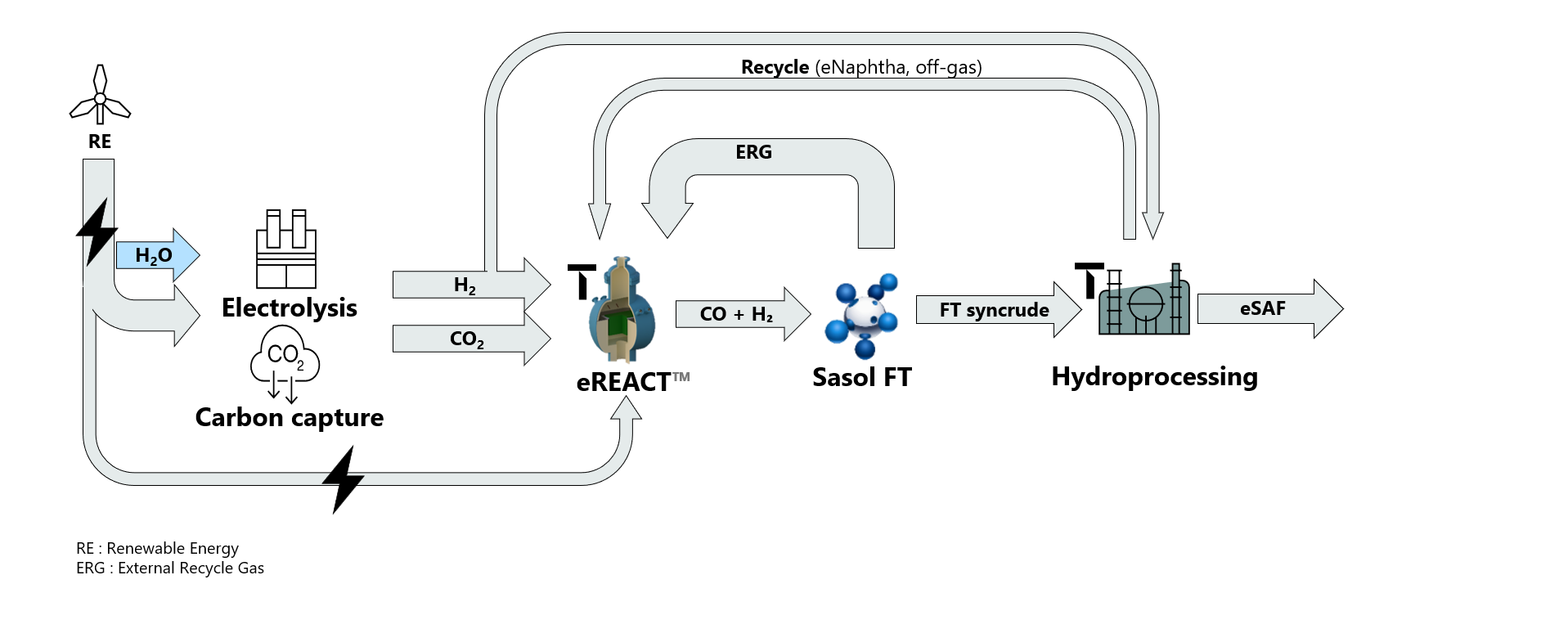
    Under the single‑point licensing (SPL) scheme, Topsoe and Sasol’s G2L™ eFuels configuration (Figure 1) integrates an eREACT™‑based syngas generation unit (SGU), Sasol’s slurry‑bed Fischer- Tropsch synthesis unit (FTU), and Topsoe’s product upgrading unit (PWU).

    Purified H₂ and CO₂ from the battery limits, together with preconditioned External Recycle Gas (ERG) from the FTU, are fed to eREACT™ for synthesis gas (syngas) production. The eREACT™ performs electrically heated Reverse Water Gas Shift (RWGS), converting CO₂ and H₂ into syngas (CO + H₂O). By using electrical heating rather than conventional fired heating, and through tight process integration with the downstream FT section, eREACT™ reduces H₂ consumption per unit of syngas produced compared to conventional RWGS approaches.

    The use of eREACT thereby significantly lowers the overall plant power demand, including electrolysis [4]. After water removal, the syngas is converted to syncrude in the FTU and subsequently hydroprocessed in the PWU to yield e-SAF, while e-naphtha and light hydrocarbon byproducts are recycled and processed via eREACT™ to generate additional syngas. This comprehensive recycle loop is a key differentiator: carbon that would otherwise leave the plant as lower–value byproducts is instead recovered and converted to additional e-SAF, enabling near complete carbon utilisation within the process.

    Figure 1
    Figure 1: Simplified block flow diagram of G2L™ eFuels

    Industry-benchmarked MTJ

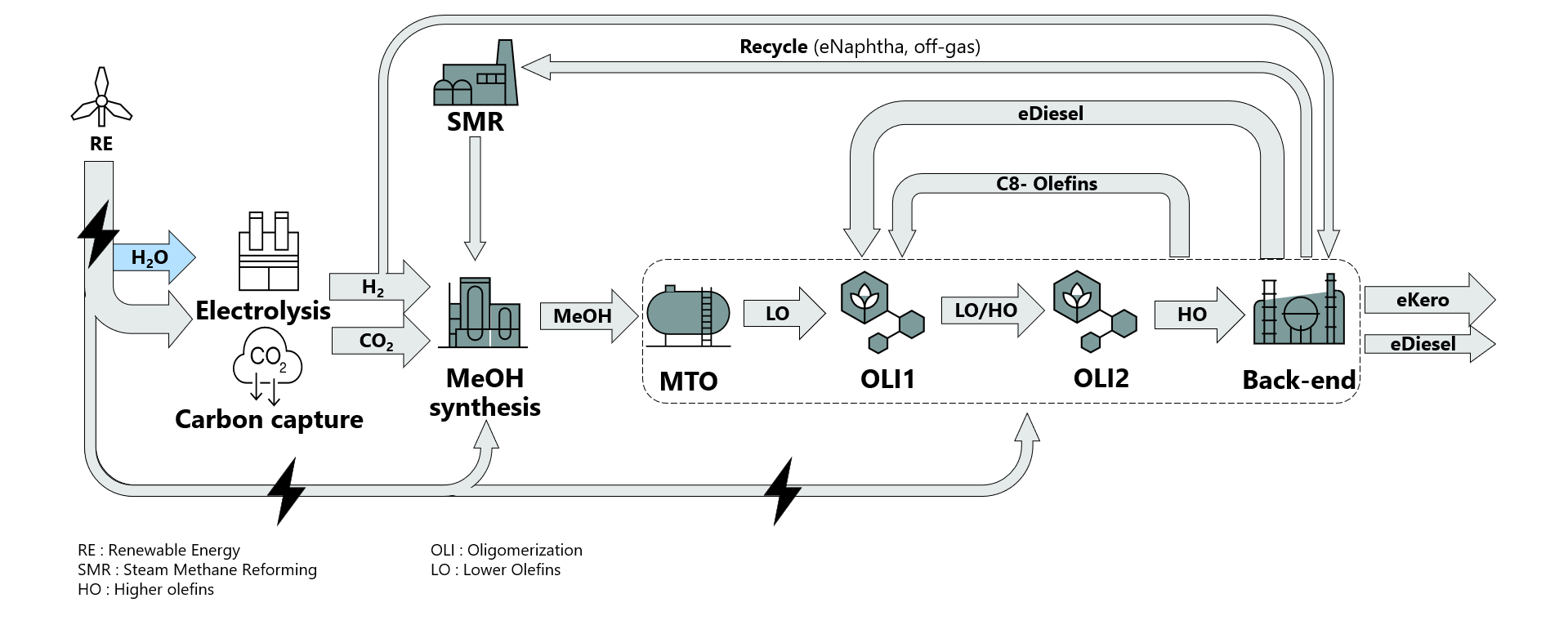
    The industry benchmarked MTJ (Figure 2) comprises direct methanol synthesis from CO and H feed; dehydration of methanol to produce lower olefins (LO) and subsequent oligomerization of lower olefins (LO) to higher olefins (HO) followed by hydrogenation and fractionation to e-SAF (note : for simplicity, MTJ product is treated as SAF, although it is not ASTM certified).

    After compression, CO₂ and H₂ feeds enter a methanol synthesis loop with extensive internal recycle to achieve high conversion, after which water is removed and the methanol is fed to a fluidized‑bed Methanol‑to‑Olefin (MTO) reactor for olefin production. During methanol dehydration, a part of the feed incurs an irreversible carbon loss of approximately 1–3% due to coke formation [5]. Unlike the G2L™ eFuels recycle approach where light ends are recovered through eREACT™, this carbon is permanently lost – it is burned off during catalyst regeneration and cannot be recovered for further conversion to e-SAF.

    The resulting light olefins are oligomerized in two stages – first to C₄–C₆ olefins (OLI1) and then to jet‑range olefins (OLI2), with partial C₈–recycle to enhance conversion – before hydrogenation and fractionation to yield e-SAF, along with byproducts e-naphtha and e-diesel. A large part of byproduct e-diesel is recycled for temperature control during exothermic oligomerization. The naphtha byproduct is converted to syngas by steam methane reforming to improve methanol production and, thereby, overall process efficiency.

    Figure 2
    Figure 2: Simplified block flow diagram of MTJ

    Comparison results: e-SAF carbon yield

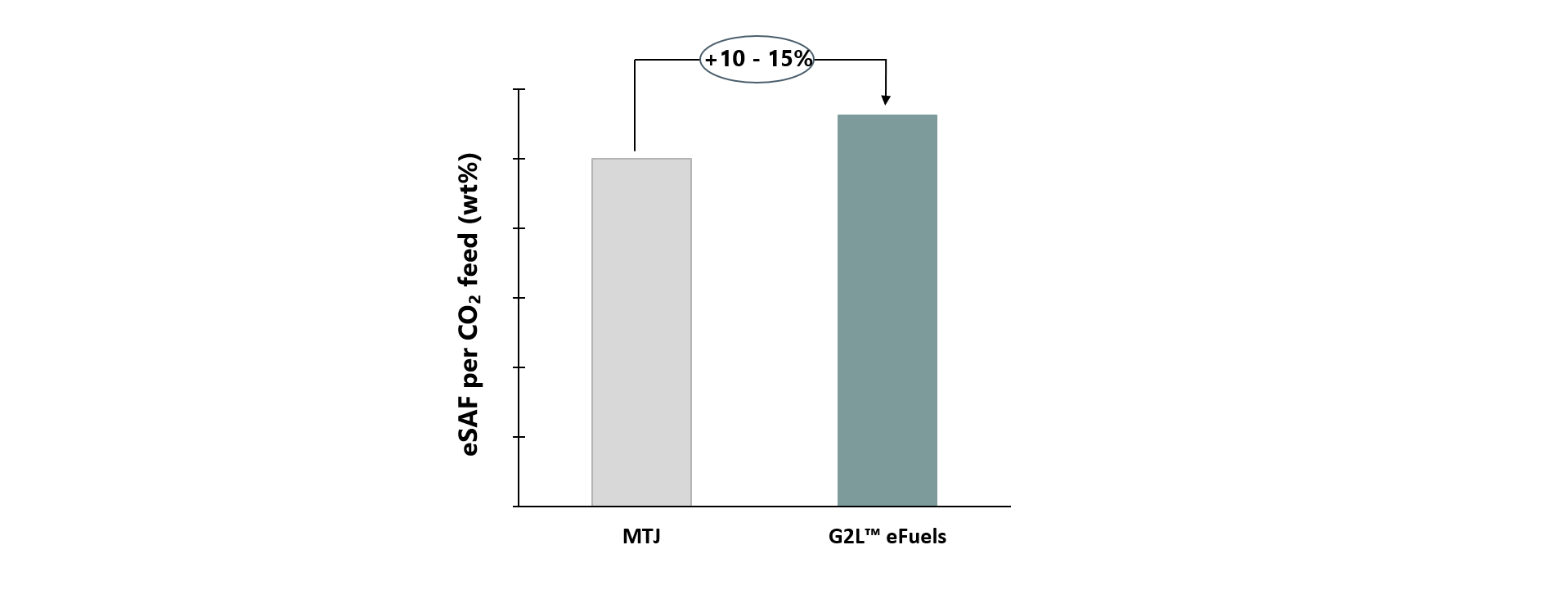
    Figure 3 compares e-SAF carbon yields (expressed as e-SAF production per unit of CO₂ feed), highlighting that G2L™ eFuels – enabled by state‑of‑the‑art eREACT, FT-catalyst, product‑upgrading optimization and e-naphtha recycle – achieves greater than 95% carbon efficiency (CO₂ feed carbon converted to product carbon) and up to 100% e-SAF selectivity (all product carbon as e-SAF).

    In contrast, MTJ, due to unavoidable e-diesel byproduct, has lower e-SAF yield. Additional steam methane reforming of recycled e-diesel with e-naphtha could be an option to make MTJ selective to e-SAF, but the technical challenges of steam reforming of the diesel stream makes it challenging and unattractive.

    Consequently, G2L™ eFuels requires approximately 10–15% less CO₂ feed to deliver the same e-SAF production. This CO₂ advantage in G2L™ is driven by three factors: (a) the naphtha and light ends recycle loop recovers carbon that would otherwise leave the plant as lower-value byproducts; (b) no irreversible carbon is lost to coke formation, unlike the MTO step in MTJ (1–3% permanent loss); and (c) no carbon is locked in an e-diesel co-product stream leaving the battery limits.

    Figure 3
    Figure 3: Comparison of CO₂ feed utilization efficiency

    Evaluating energy utilization efficiency

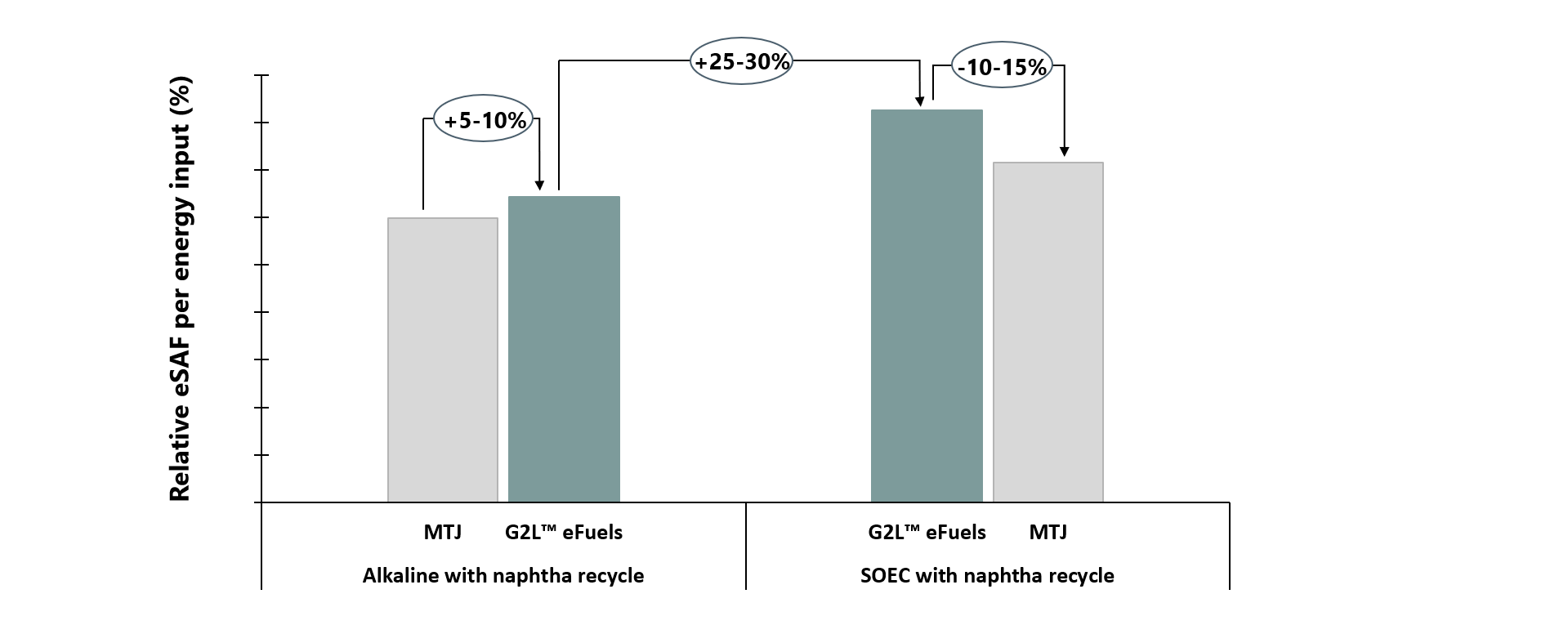
    The energy utilization efficiency is defined as the e-SAF production per net energy used and the comparison results are depicted in Figure 4. The same figure also captures the impact of electrolysis type on energy utilization efficiency.

    As described previously, the CO feed demand in MTJ is higher. In addition to that H demand in MTJ is also slightly higher due to ‘loss’ of H through e-diesel byproduct and coke formation in the MTO step. Moreover, steam methane reforming of recycled e-naphtha and off-gases increases energy demand for fuel. As an overall result, G2L™ eFuels produces approximately 5–10% more e-SAF than MTJ for same energy consumption when Alkaline Water Electrolysis (AWE) is used as H source.

    Excess steam availability from the FTU in G2L™ eFuels offers a natural energy integration with SOEC – the FT section produces the steam that SOEC consumes, reducing the need for external energy input for steam generation. This is why SOEC in G2L™ eFuels allows approximately 25–30% more e-SAF production for same energy usage compared to AWE in G2L™ efuels. Like G2L™ eFuels, the MTJ process also has excess steam, however, the excess steam amount is estimated to be insufficient to meet the energy demand for SOEC completely. As a result, MTJ with SOEC as H source produces approximately 10–15% less e-SAF for same energy usage in G2L™ eFuels with SOEC. Furthermore, additional steam is available in G2L™ eFuels that can be used to provide additional energy integration (e.g. with CO capture unit) or power generation.

    Figure 4
    Figure 4: Comparison of energy utilization efficiency

    Levelized cost comparison

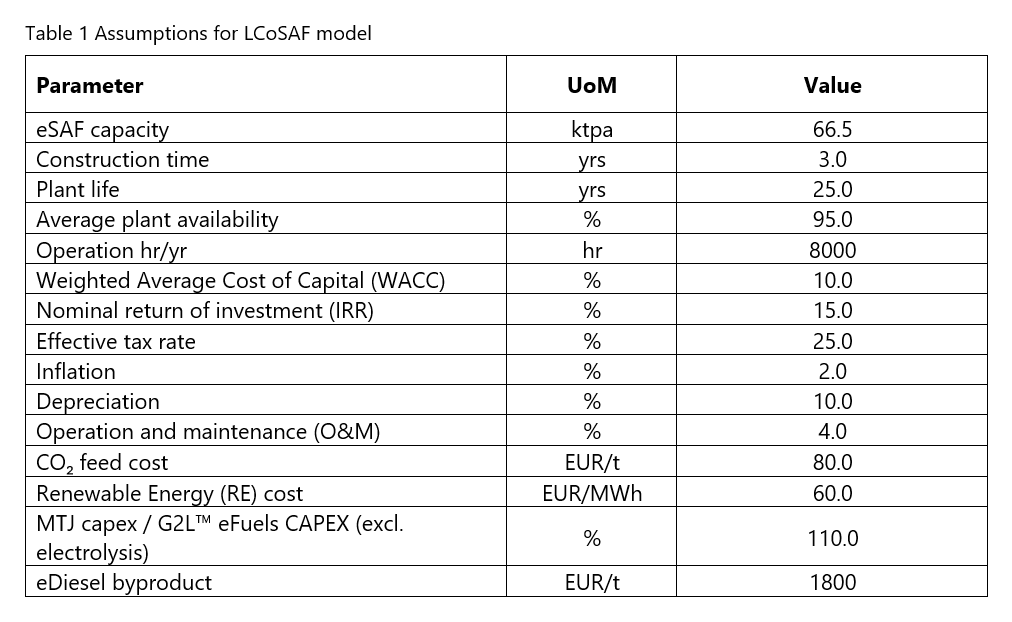
    The levelized cost of e-SAF (LCoSAF) is a crucial financial metric, which is used to evaluate the economic viability and the cost-effectiveness of e-SAF production. It incorporates capital investment, operational and maintenance expenses, and financing costs to produce total e-SAF over a period of expected project lifetime. Revenue from byproduct diesel blend sales, which requires additional logistics, is also included. A list of key assumptions, used for levelized cost model, are reported in Table 1.

    It should be noted that the e-diesel byproduct price assumption (€1,800/t) is favourable to MTJ, as this provides a significant revenue credit for a byproduct that G2L™ eFuels does not produce (having recycled it to e-SAF instead). Even with this generous byproduct credit, MTJ economics remain less attractive, as shown below.

    Table 1
    Table 1: Assumptions for LCoSAF model

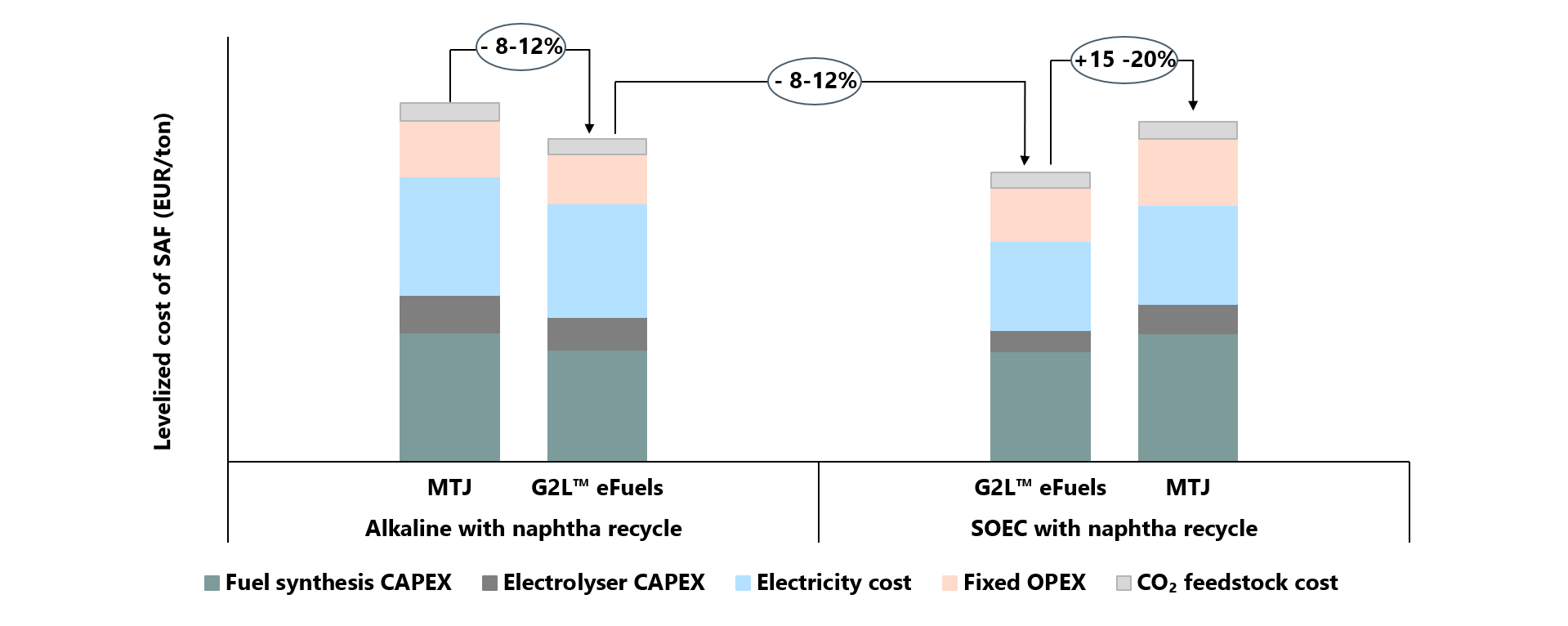
    In Figure 5, the LCoSAF for G2L™ eFuels is approximately 8–12% less compared to that for MTJ, when AWE is considered as the H source. The LCoSAF for G2L™ eFuels can further be reduced by approximately 8–12% when H source is changed from AWE to SOEC, due to better energy integration with SOEC and available excess high–quality steam from G2L™ eFuels. The benefit of SOEC in MTJ is, however, limited due to insufficient availability of steam for SOEC, resulting in approximately 15–20% higher LCoSAF compared to G2L™ eFuels.

    Figure 5
    Figure 5: Comparison of levelized cost of eSAF

    Sensitivity

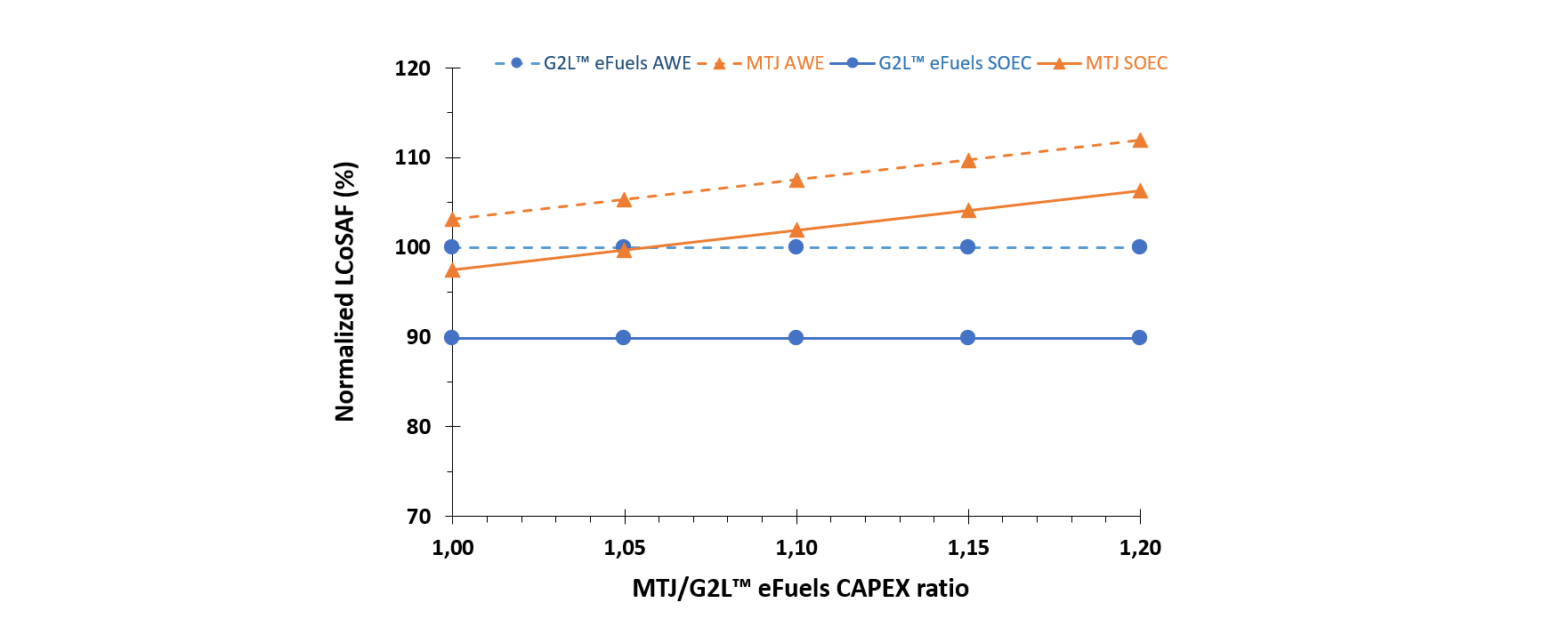
    One of the main critical assumptions for LCoSAF analyses is the ratio of MTJ and G2L™ eFuels CAPEX (capital expenses). Due to significantly more unit operations in MTJ compared to G2L™ eFuels – specifically, MTJ requires a high–pressure methanol synthesis loop, fluidized bed MTO reactor with regeneration, two-stage oligomerization, and a steam methane reformer for naphtha recycle, compared to G2L™ eFuels' three integrated blocks (SGU, FTU, PWU) – the CAPEX is expected to be higher in MTJ. The baseline assumption of 110% MTJ CAPEX (10% higher than G2L™ eFuels excluding electrolysis) is considered conservative given this difference in process complexity. A sensitivity analysis is performed, and the result is shown in Figure 6, The LCoSAF for MTJ would still be higher than that for G2L™ eFuels, irrespective of the electrolysis type, even if MTJ CAPEX is equal to G2L™ eFuels CAPEX.

    Since G2L™ eFuels requires approximately 10–15% less CO₂ and 5–15% less energy than MTJ, the cost advantage increases at higher CO₂ and energy prices.

    Figure 6
    Figure 6: Normalized LCOSAF as a function of MTJ/G2L™ eFuels CAPEX ratio for AWE and SOEC based hydrogen supply (costs are normalized to the G2L™ eFuels AWE baseline)

    Conclusions

    1. G2L™ eFuels achieves greater than 95% carbon efficiency and up to 100% e-SAF selectivity with full naphtha recycling – a level of selectivity that is not achievable in the industry benchmark MTJ.

    2. G2L™ eFuels' lower CO₂ demand (approximately 10–15% less than MTJ for the same e-SAF output) provides an economic advantage that increases with CO₂ sourcing cost.

    3. G2L™ eFuels provides more e-SAF production for the same energy consumption compared to MTJ – approximately 5–10% more with AWE and approximately 10–15% more with SOEC.

    4. Solid Oxide Electrolysis (SOEC) offers better energy integration with G2L™ eFuels compared to MTJ, driven by the higher availability of excess steam from the exothermic FT synthesis reaction.

    5. The LCoSAF for G2L™ eFuels is lower than that for MTJ, irrespective of the electrolysis type – and this advantage holds even when the MTJ CAPEX ratio is reduced to parity with G2L™ eFuels.

    Reference

    [1] SAF-Market-Outlook-2024-Summary.pdf

    [2] Topsoe White paper - ELECTRICAL REVERSE WATER GAS SHIFT BY eREACT™ 19549 Electrical Reverse Shift Whitepaper_FINAL.pdf

    [3] Moodley, D., Potgieter, J., Moodley, P., Crous, R., van Helden, P., van Zyl, L., Cunningham, R., Gauche, J., Visagie, K., Botha, T. and Claeys, M., 2025. Tuning the active sites of supported cobalt Fischer-Tropsch catalysts to enhance efficiency for hard wax production. Catalysis Today, 454, p.115282  

    [4] Renewable synthetic fuels technology whitepaper by Topsoe

    [5] Kerosene production from power-based syngas – A technical comparison of the Fischer-Tropsch and methanol pathway by Bube. S et al 

    Contact Us

    Want to get to know us better - get in touch!

    Take a deeper look

    cover-temp-720x406

    Our solutions

    Explore our diverse range of proven solutions for transforming renewable resources into fuels and chemicals.

    cover-temp-720x406

    Knowledge and insights

    Stay ahead of the curve by continuously updating your knowledge of the latest energy trends.

    cover-temp-720x406

    Our technologies

    Delve into our different technologies for producing low-carbon and conventional fuels and chemicals as well as for ensuring clean air.

    cover-temp-720x406

    Our podcasts

    Join the conversation on renewable fuels and circular plastic with industry experts and influencers as they discuss emerging trends and best practices.

    cover-temp-720x406

    About us

    We were founded by Dr. Haldor Topsøe in 1940. Today, we are a leading global provider of technology and solutions for the energy transition.

    cta-icon-1

    Get the latest

    Keep up with the latest news and inside stories from Topsoe.

    cta-icon-2

    Join our team

    We turn challenges into opportunities. Sound like something for you? Explore our current vacancies here.

    Topsoe_People_Pictures_-_Frederiksund_Outdoor_9_1