Skip to content
Contact us
    Select language

    How recent catalyst innovation can boost your ammonia synthesis

    1 min read Ammonia
    Published On 19 August 2026
    Written By

    Topsoe

    Last Reviewed On 19 August 2026
    ammonia

    Ammonia synthesis is one of the world’s most important industrial processes. For more than a century, the Haber-Bosch process has supported ammonia production for the global fertilizer industry, helping to feed around 50% of the world's population. Yet even established technologies and processes can continue to evolve in terms of efficiency. Today, meaningful efficiency gains are emerging from a closer look inside the ammonia synthesis converter - and at the center of this progress is catalyst design, writes Mads Feddersen.

    Ammonia synthesis is one of the world’s most important industrial processes. For more than a century, the Haber-Bosch process has supported ammonia production for the global fertilizer industry, helping to feed around 50% of the world's population. Yet even established technologies and processes can continue to evolve in terms of efficiency. Today, meaningful efficiency gains are emerging from a closer look inside the ammonia synthesis converter - and at the center of this progress is catalyst design, writes Mads Feddersen. 

    Reaction rates in an ammonia synthesis converter 

    In a typical multi-bed ammonia synthesis converter, reaction conditions change significantly from the top bed to the lower beds. The upper bed operates with relatively low ammonia concentrations and high temperatures, with these conditions favoring strong catalyst activity and rapid reaction rates. 

    As the synthesis gas moves through the converter, ammonia concentrations rise and temperatures moderate. In the lower beds, equilibrium constraints become increasingly tight. Under these conditions, catalyst geometry and surface behavior become critical. 

    A catalyst optimized for the upper bed does not necessarily perform best further down the converter. The thermodynamic environment changes, and the reaction kinetics demand materials engineered for high-conversion conditions rather than initial ignition activity. 

    Conventional iron-based ammonia synthesis catalysts have supported the industry for decades. However, the lower beds of the converter still present an opportunity to improve performance. Higher catalyst activity under high-ammonia conditions can improve efficiency across the entire synthesis loop. 

    Catalyst grain structure as a performance variable 

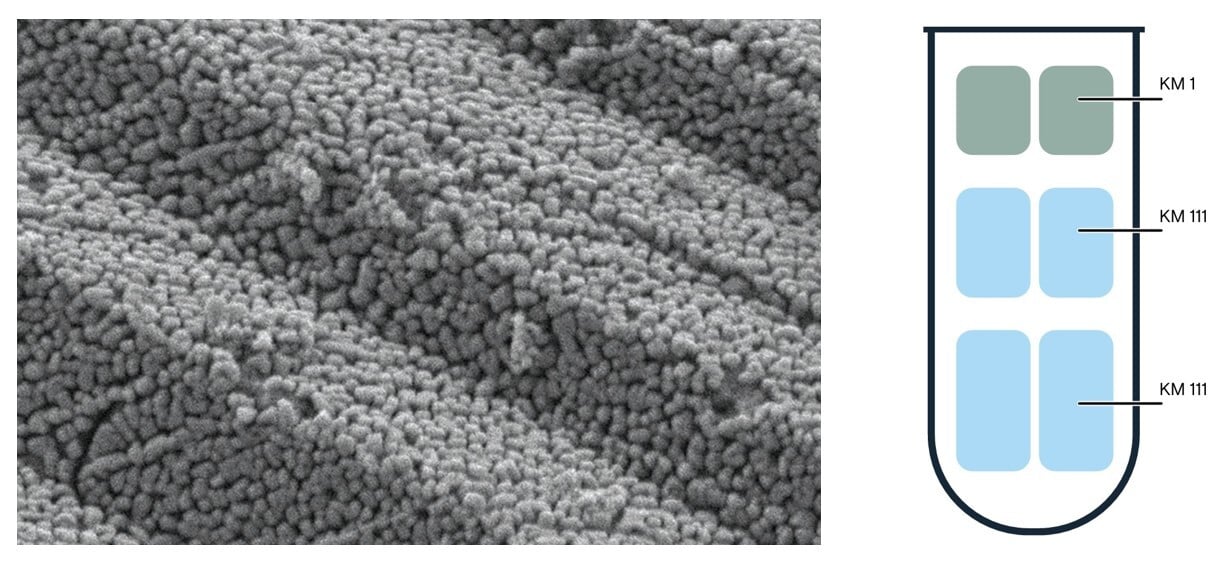
    One of the most important developments in recent ammonia catalyst innovation is the focus on grain morphology. The irregular grain structure of advanced catalysts such as KM 111 influences accessible surface area, diffusion pathways for reactants and products, and the rate of equilibrium reactions under lower-bed conditions. 

    Why does this matter? Higher surface accessibility under high-ammonia conditions means more active sites contribute where the thermodynamic driving force is lowest. As a result, plants can achieve higher ammonia concentrations at the converter outlet while operating at the same pressure and temperature. Alternatively, operators can maintain production rates at lower loop pressures, reducing compression energy demand. 

    These gains are significant in making ammonia production more efficient. Compression represents a substantial share of energy consumption in ammonia synthesis. Even small reductions in loop pressure can generate measurable savings over continuous operation. 

    Combining ammonia catalyst generations

    Catalyst innovation rarely works in isolation, and the strongest results often come from optimizing catalyst performance across the entire converter. 

    An established catalyst in the top bed can deliver strong activity at lower ammonia concentrations, while a higher-activity catalyst in the lower beds can improve performance under high-concentration conditions. This creates a systems-level optimization across the converter. 

    The interaction between catalyst beds, temperature profiles and gas composition all influence overall performance. Plants using this stratified approach have demonstrated higher production rates and faster stabilization after start-up. 

    What this means for existing ammonia plants 

    For ammonia producers operating existing assets, catalyst strategy can unlock additional value without major mechanical upgrades. 

    New plants can be designed around the latest catalyst performance. Existing plants operate within fixed equipment constraints and must identify efficiency improvements within the current synthesis loop. 

    High-activity lower-bed catalysts offer a practical path forward. Plants can increase ammonia output without adding compression capacity or maintain production rates at lower loop pressures. This allows operators to improve efficiency using existing infrastructure. 

    Compared with major equipment modifications, catalyst reloads require relatively modest capital investment. The operational benefits can continue throughout the catalyst lifetime. 

    Documented operating data from ammonia plants, including facilities in India, show that advanced catalyst formulations can maintain stable, high-activity performance over extended operating campaigns. Higher production rates combined with lower specific energy consumption create measurable economic benefits. 

    New KM 111 ammonia catalyst
    Left: The surface of the KM 111. Right: Bed configuration for the KM 111 catalyst

    Why ammonia synthesis efficiency matters

    Global ammonia demand continues to grow. Fertilizer demand alone is projected to increase steadily, while new applications are emerging across the energy sector with ammonia is increasingly discussed as a maritime fuel, a hydrogen carrier and a fuel for power generation. 

    Meeting this demand requires both new production capacity and more efficient use of existing assets. 

    At the same time, the carbon intensity of ammonia production is under increasing scrutiny. Improvements in synthesis loop efficiency can reduce energy consumption per tonne of ammonia produced, helping lower emissions from the production process. 

    Catalyst development therefore extends beyond reactor performance, supporting the broader transition toward more energy-efficient and lower-carbon ammonia production. 

    A hidden but substantial impact 

    Ammonia synthesis catalysts operate out of sight inside the converter, but their impact is substantial. Advances in grain morphology, surface kinetics and converter-bed optimization continue to deliver measurable industrial benefits. 

    Developments such as KM 111 show that even mature technologies like Haber-Bosch still offer opportunities for meaningful improvement. These gains do not necessarily require major plant redesigns but can come from understanding process constraints and applying advanced materials science where it creates the greatest value. 

    As the industry works to increase ammonia production while reducing energy consumption and emissions, catalyst innovation will continue to play an important role. 

    Contact us

    Want to get to know us better - get in touch!

    Take a deeper look

    cover-temp-720x406

    Our solutions

    Explore our diverse range of proven solutions for transforming renewable resources into fuels and chemicals.

    cover-temp-720x406

    Knowledge and insights

    Stay ahead of the curve by continuously updating your knowledge of the latest energy trends.

    cover-temp-720x406

    Our technologies

    Delve into our different technologies for producing low-carbon and conventional fuels and chemicals as well as for ensuring clean air.

    cover-temp-720x406

    Our podcasts

    Join the conversation on renewable fuels and circular plastic with industry experts and influencers as they discuss emerging trends and best practices.

    cta-icon-1

    Get the latest

    Keep up with the latest news and inside stories from Topsoe.

    cta-icon-2

    Join our team

    We turn challenges into opportunities. Sound like something for you? Explore our current vacancies here.

    Topsoe_People_Pictures_-_Frederiksund_Outdoor_9_1