Skip to content
Contact us
    Select language

    The hidden risks in e-methanol plant design – and how to avoid them

    1 min read Methanol e-methanol
    Published On 10 June 2026
    Written By

    Topsoe

    Last Reviewed On 10 June 2026
    e-methanol

    E-methanol is moving from demonstration to deployment. Projects are being financed, sites selected and technology choices locked in. Against that backdrop, one question deserves careful attention: how much of conventional methanol engineering transfers directly to plants built on CO2 feedstocks, electrolytic hydrogen and renewable power? The chemistry is related, the equipment looks familiar and the process flow diagrams share a family resemblance. But the operating conditions, feedstock characteristics and economic constraints are different enough that assumptions carried forward without scrutiny can become costly later in the project lifecycle, write Topsoe's Rishika Chatterjee and Troels Juel Friis-Christensen.

    E-methanol is moving from demonstration to deployment. Projects are being financed, sites selected and technology choices locked in. Against that backdrop, one question deserves careful attention: how much of conventional methanol engineering transfers directly to plants built on CO2 feedstocks, electrolytic hydrogen and renewable power? The chemistry is related, the equipment looks familiar and the process flow diagrams share a family resemblance. But the operating conditions, feedstock characteristics and economic constraints are different enough that assumptions carried forward without scrutiny can become costly later in the project lifecycle, write Topsoe's Rishika Chatterjee and Troels Juel Friis-Christensen.

    A new reality has arrived

    What works reliably when natural gas arrives at a consistent pressure, composition and flow rate, day after day, can become a liability when the underlying design assumptions are no longer valid. That is precisely the situation confronting e-methanol plants – those based on CO2 feedstocks, electrolytic hydrogen and renewable power.

    The engineering rules that govern conventional methanol design were written for a different operating reality. Applying them directly to e-methanol plants, without adjustment, introduces technical risks that are often invisible until capital has already been committed. Understanding where those risks arise – and how to address them early – is one of the most valuable contributions a technology partner can make.

    Feed chemistry is different – and the numbers matter

    The most immediate difference between conventional and e-methanol plants is the feedstock. Natural gas and coal-based plants produce syngas rich in carbon monoxide (CO). CO2-based e-methanol plants operate with a feed consisting entirely of CO2 and hydrogen.

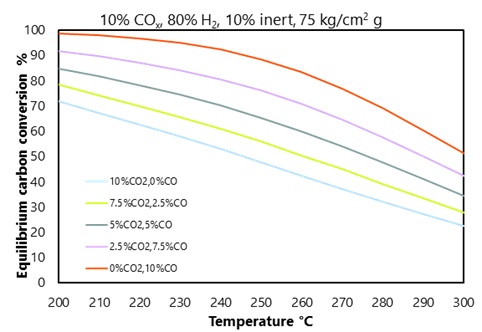
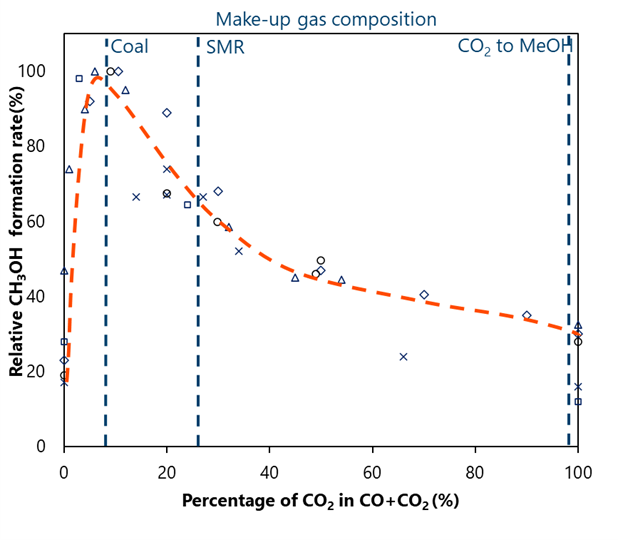
    This shift changes the chemistry in two important ways. First, equilibrium carbon conversion is significantly lower for CO2-rich feeds than for CO-rich ones: at a given temperature and pressure, a CO2-based synthesis loop converts a smaller fraction of its carbon feedstock to methanol per pass. Second, the reaction rate is also reduced – the relative methanol formation rate declines as the fraction of CO2 in the carbon feed increases. The combined effect is that, for the same methanol output, a CO2-based plant requires considerably more catalyst volume than a conventional one.

    Equilibrium carbon conversion as a function of temperature for different CO/CO₂ compositions
    Figure 1: Equilibrium carbon conversion as a function of temperature for different CO/CO₂ compositions.
    Relative Methanol formation rate
    Figure 2: Relative Methanol formation rate for Cu/ZnO/Al2O3 catalyst adapted from [J. Cat. 393 (2021) 324–334]] for different make-up gas compositions. “Coal”, “SMR,” and “CO2 to MeOH” refer to typical make-up gases obtained by coal gasification, steam reforming of natural gas, and a CO2 stream mixed with green hydrogen, respectively.

    There is a further complication. CO2-based synthesis produces substantially more water, a direct consequence of reaction stoichiometry. Elevated water partial pressure accelerates sintering of copper-based methanol catalysts, reducing activity over time. This is not a marginal effect, and specially designed catalyst systems are required to maintain stability under these conditions.

    To access a longer, more detailed version of this article, including the full dataset, simulation methodology and reactor performance analysis, please click here>>

    Dynamic operation is a commercial necessity 

    Conventional methanol plants are designed for steady-state operation. Reactor sizing, control strategies, heat integration and equipment selection all assume continuous operation at or near a single design point.

    E-methanol plants operate under fundamentally different conditions. When hydrogen is produced by electrolysis using renewable power, supply is inherently variable. Wind and solar generation fluctuate on timescales ranging from minutes to hours, and the methanol synthesis loop must respond accordingly. The result is repeated load changes and, in some cases, intermittent operation – a duty cycle for which conventional steady-state design offers limited guidance.

    The consequences are significant. Pressure variations in the synthesis loop can lead to instability and reduced feedstock utilization. Repeated thermal cycling introduces fatigue in high-pressure equipment.

    Without extended turndown capability, project developers face an unattractive choice: install expensive hydrogen storage to smooth out supply variability or accept lower utilization of their most expensive input. Neither is commercially appealing. The ability to operate reliably at turndown levels well below the conventional 40–50% threshold is not a nice-to-have for most e-methanol plants. It is a commercial necessity.

    Impurity profiles require deliberate design

    E-methanol plants face impurity profiles that simply do not exist in conventional natural gas-based plants. CO2 sourced from industrial point sources and hydrogen produced via electrolysis contain trace contaminants that differ in both type and concentration from those seen in traditional syngas.

    Sulfur species are particularly problematic. Even very small concentrations can poison methanol synthesis catalysts, and different sulfur compounds may require different guard strategies. Careful characterization of feedstock impurity streams – and explicit design for them – is not optional. It is one of the areas where inherited assumptions from conventional plants can create genuine technical exposure if left unchallenged.

    Scale changes the economics of every decision

    Conventional world-scale methanol plants are typically around 5,000 MTPD. Their size delivers strong economies of scale. E-methanol plants are usually much smaller – often constrained by the availability of point-source CO2 and local renewable power capacity to below 600 MTPD. At this scale, the lack of economy of scale is not a side issue. It is a defining characteristic, and design choices that would be routine in a large plant become critical cost drivers.

    The single most important lever for improving the e-methanol business case is efficient use of hydrogen. A plant that can follow hydrogen availability in real time, without relying on large buffer storage, converts a greater share of its most expensive input into product. Dynamic operability is the primary means of achieving that.

    What has actually been done: reactor, catalyst and control

    Addressing these challenges requires more than engineering judgement. It requires systematic investigation combining modelling, testing and physical demonstration.

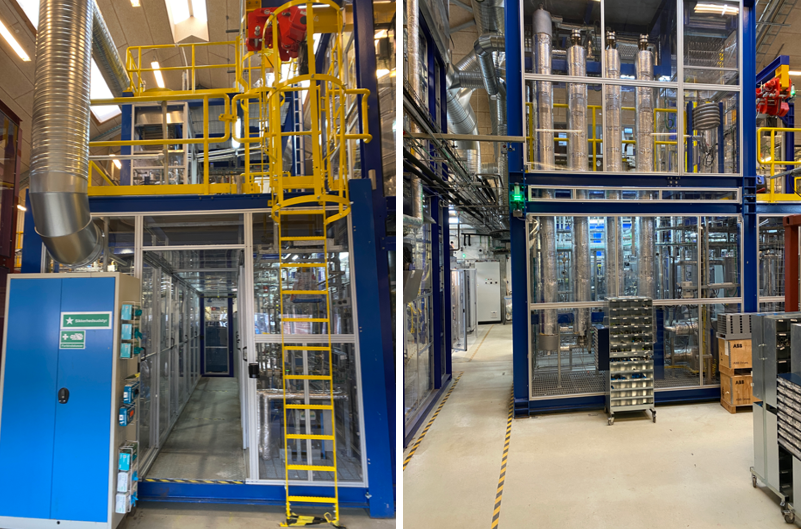
    In collaboration with Aarhus University, Topsoe operates a pilot facility in Denmark that includes an industrial-like methanol synthesis loop based on a boiling water reactor (BWR) design, with a methanol synthesis capacity of 0.35 MTPD. The unit replicates commercial control logic, including key elements of the dynamic operating strategy.

    E-methanol pilot with industrial-like methanol synthesis loop based on boiling water reactor design.
    Figure 3: E-methanol pilot with industrial-like methanol synthesis loop based on boiling water reactor design.

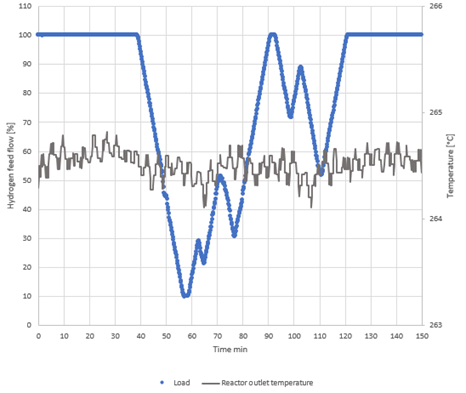
    The BWR design was selected through deliberate techno-economic evaluation. Its inherent thermal stability makes it particularly well suited to dynamic operation: conversion of reaction heat to steam at constant boiling water pressure results in minimal process fluctuations during load changes. The pilot has demonstrated stable production of grade AA ready raw methanol across the full operating range of 10–100% load, without the reactor temperature adjustments required by alternative reactor concepts.

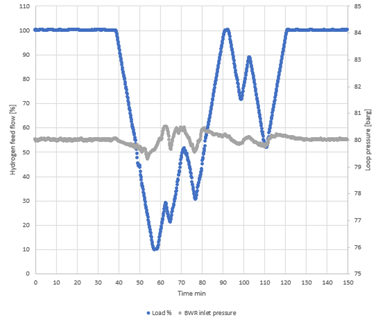
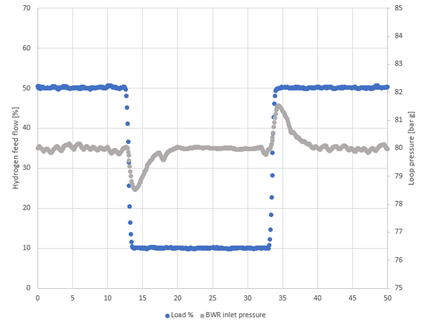
    The control philosophy is built around following the hydrogen supply. The system is fully automated, adjusting recycle flow continuously to maintain stable loop pressure as hydrogen input varies. Pilot testing has confirmed that loop pressure remains stable under random hydrogen load changes of ±5% per minute, and during abrupt step changes from 50% to 10% load – well within the mechanical design limits prescribed by ASME before fatigue screening is required.

    Synthesis loop pressure stability during random hydrogen load changes of ±5%.
    Figure 4: Synthesis loop pressure stability during random hydrogen load changes of ±5%.
    Synthesis loop pressure during immediate load reduction
    Figure 5: Synthesis loop pressure during immediate load reduction from 50 to 10% and subsequent load increase.
    Stability of boiling water reactor outlet temperature during random hydrogen load changes of ±5%.
    Figure 6: Stability of boiling water reactor outlet temperature during random hydrogen load changes of ±5%.

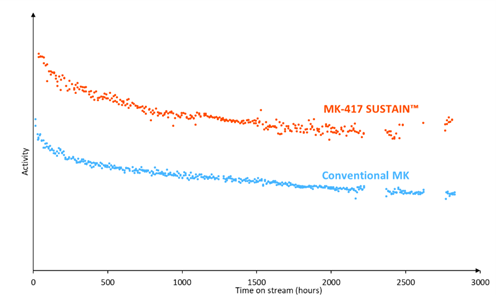
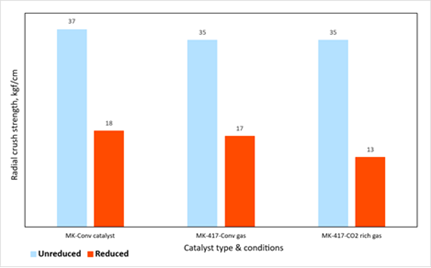
    On the catalyst side, conventional copper-zinc-alumina catalysts optimized for CO-rich syngas are not suited for sustained operation with CO2-rich feeds. MK-417 SUSTAIN™ has been developed specifically for CO2-to-methanol service. It combines high selectivity for methanol formation from CO2 and H2 – with reduced byproduct formation and distillation load – with enhanced resistance to sintering under high water partial pressures. Long-duration testing under conditions representative of e-methanol operation confirms sustained performance well ahead of conventional catalyst benchmarks. Critically, its mechanical strength after activation is comparable to that of conventional catalysts operating under milder conditions, directly supporting stable operation by limiting pressure drop development and extending catalyst lifetime.

    Comparison of activity of MK-417 SUSTAIN™ and conventional MK catalyst
    Figure 7: Comparison of activity of MK-417 SUSTAIN™ and conventional MK catalyst at industrial relevant operating conditions for CO2 to methanol synthesis (78barg, 260°C, 10.3% CO2 1.4% CO, 86 % H2, Ar bal.).
    Comparison of strength of MK-417 SUSTAIN™ and conventional catalyst in oxidized and reduced state
    Figure 8: Comparison of strength of MK-417 SUSTAIN™ and conventional catalyst in oxidized and reduced state.

    What this means for your project

    The transition from fossil-based to CO2-based methanol production is technically feasible. The chemistry is understood, reactor designs are proven, and catalysts have been developed specifically for the new operating environment. What is not straightforward is carrying forward conventional design assumptions into a fundamentally different context.

    Project teams evaluating e-methanol technologies should ask key questions early:

    • Has the catalyst been tested specifically for CO2-to-methanol service, under representative conditions of high water partial pressure and variable load?

    • Does the reactor and control design genuinely enable deep turndown without compromising operational stability or product quality?

    • Have feedstock impurity profiles been fully characterized, with guard strategies designed explicitly for the CO2

    Discovering gaps in any of these areas late in a project is costly – in capital expenditure, schedule and plant performance. Early, informed design decisions remain the most powerful lever available. The industry is moving fast. Engineering needs to move with it.

    Contact us

    Want to get to know us better - get in touch!

    Take a deeper look

    cover-temp-720x406

    Our solutions

    Explore our diverse range of proven solutions for transforming renewable resources into fuels and chemicals.

    cover-temp-720x406

    Knowledge and insights

    Stay ahead of the curve by continuously updating your knowledge of the latest energy trends.

    cover-temp-720x406

    Our technologies

    Delve into our different technologies for producing low-carbon and conventional fuels and chemicals as well as for ensuring clean air.

    cover-temp-720x406

    Our podcasts

    Join the conversation on renewable fuels and circular plastic with industry experts and influencers as they discuss emerging trends and best practices.

    cta-icon-1

    Get the latest

    Keep up with the latest news and inside stories from Topsoe.

    cta-icon-2

    Join our team

    We turn challenges into opportunities. Sound like something for you? Explore our current vacancies here.

    Topsoe_People_Pictures_-_Frederiksund_Outdoor_9_1