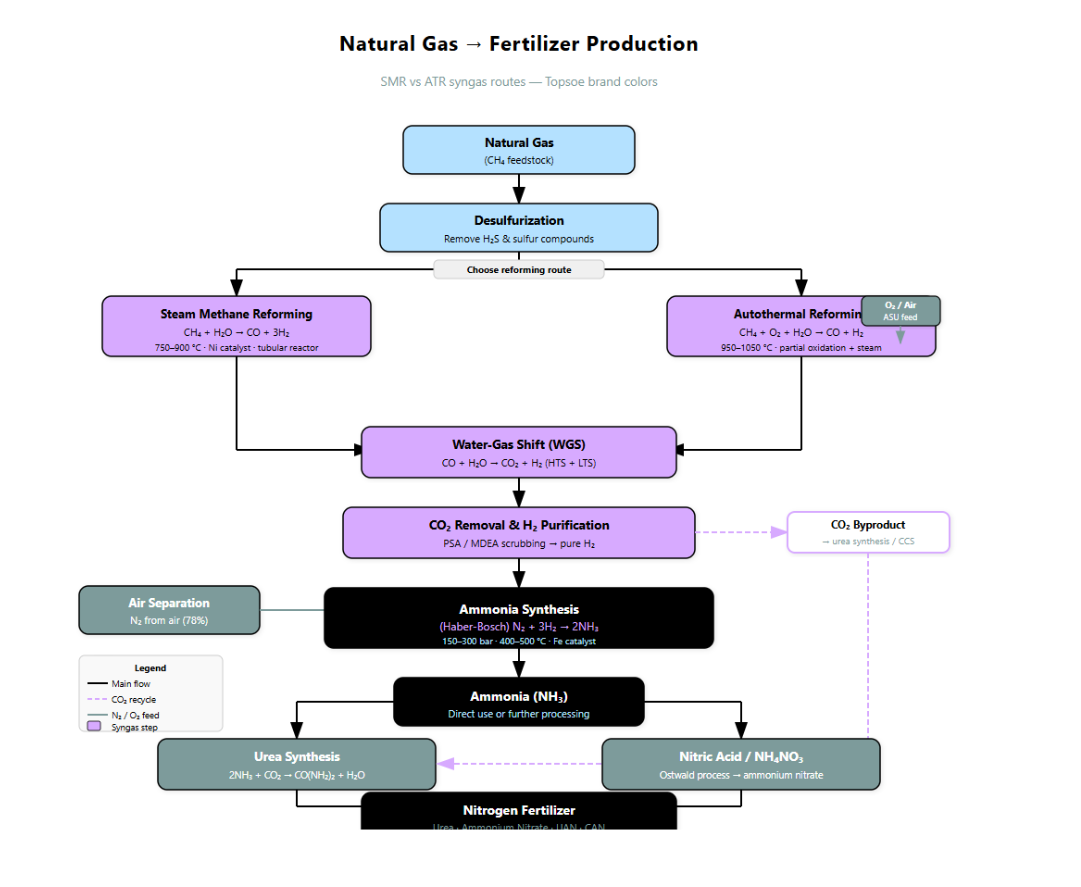
The process begins with desulfurization, as natural gas from the ground contains sulfur compounds that would quickly poison the catalysts used in downstream steps. These sulfur compounds are therefore removed first, typically by passing the gas over a CoMo/NiMo hydrodesulfurization catalyst, followed by a ZnO guard bed that captures the remaining sulfur species.
The desulfurized gas then enters the primary reformer, where natural gas and steam react over a nickel catalyst inside fired tubular reactors. This is traditionally the steam methane reforming (SMR) step, and it converts methane into a mixture of carbon monoxide and hydrogen according to the reaction: CH4 + H2O to CO + 3H2. The reactors operate at outlet temperatures of around 800 to 900 degrees Celsius. Topsoe has provide SMR technology for almost seven decades and is a dominant industry player.
Producing the syngas can be done using either SMR or ATR technology
While SMR is a mature, widely deployed technology, it is also carbon intensive. A more efficient and increasingly important alternative is autothermal reforming (ATR), a technology in which Topsoe is also a technology leader. ATR combines partial oxidation and steam reforming in a single reactor unit, using oxygen alongside steam and natural gas. The result is a more thermally efficient process, operating at much lower steam-to-carbon ratios, a more favorable hydrogen-to-carbon-monoxide ratio for downstream synthesis, and a configuration that is significantly better suited to carbon capture integration. This can be a critical consideration as ammonia producers face growing pressure to reduce emissions.
The key distinction when it comes to decarbonization lies not in where the heat comes from, but in where the CO2 ends up – and at what concentration. In a conventional SMR plant, a large share of the carbon leaves the process as CO2 in the flue gas from the fired tubular reformer. This flue gas is dilute, making CO2 capture technically challenging and costly. In an ATR configuration, the fired reformer is eliminated entirely, and the carbon is concentrated on the process side of the plant – in the syngas itself – where it can be captured far more efficiently and at much higher rates, up to 99% of Scope 1 emissions. This fundamental difference makes ATR the preferred route for producers seeking to pair ammonia production with carbon capture and storage (CCS).
Next step: Producing the ammonia for fertilizer
What follows is where ammonia production diverges from a pure hydrogen plant – not in the choice of reforming technology, but in the need to introduce nitrogen into the process. In a conventional SMR-based ammonia plant, this is achieved by introducing air into a secondary reformer. This serves two purposes simultaneously: it completes the conversion of any residual methane, and critically, it introduces the nitrogen that will ultimately end up in the ammonia product. The air addition is controlled precisely so that the resulting syngas contains hydrogen and nitrogen in exactly the 3:1 molar ratio required by the ammonia synthesis reaction. In ATR-based configurations, where the fired secondary reformer is replaced entirely, the required nitrogen is instead introduced later in the process – typically in the purification section – keeping the reforming step oxygen-fired and the syngas section free of nitrogen until it is needed.
The syngas leaving the reforming section still contains significant quantities of carbon monoxide, which represents both unused hydrogen potential and a future catalyst poison. The water-gas shift (WGS) section addresses this by reacting CO with steam to produce additional hydrogen and CO2, via CO + H2O to CO2 + H2. This is carried out in two stages: a high-temperature shift at around 350 to 450 degrees C over an iron/chromium catalyst, followed by a low-temperature shift at around 200 to 250 degrees C over a copper/zinc catalyst, which drives the reaction closer to completion.
The CO2 produced in the shift section is then removed in a dedicated absorption unit, commonly using solvents such as aMDEA or the Benfield process. The captured CO2 is not simply vented; in integrated fertilizer complexes it is frequently sent directly to a urea plant, where it reacts with ammonia to form the final fertilizer product.
Even after CO2 removal, trace quantities of CO and CO2 remain in the gas, and these would irreversibly poison the iron catalyst in the ammonia synthesis reactor. A methanation step therefore converts these residual oxides back into methane and water over a nickel catalyst, via CO + 3H2 to CH4 + H2O. The result is a clean synthesis gas containing hydrogen and nitrogen in the required 3:1 ratio, with no carbon oxides present.
Haber-Bosch and ammonia synthesis
This purified gas is then compressed to synthesis pressure and fed to the Haber-Bosch reactor, where N2 + 3H2 reacts to form 2NH3 with a heat release of 92 kJ/mol. The Haber-Bosch process is one of the most important industrial chemical reaction processes in history. Globally, it helps produce around 175 million tonnes of ammonia per year, responsible, by most estimates, for feeding roughly half the world’s population.
The process, standardized in 1913, remains the universal method for ammonia synthesis and has no commercial alternative. It operates at pressures of 150 to 300 bar and temperatures of 400 to 500 degrees C over an iron-based catalyst promoted with potassium oxide and aluminium oxide.
Topsoe's KM1 and KM111 catalysts are industry-leading examples of this catalyst type. Because the equilibrium conversion per pass is relatively low at only around 15 to 25%, unreacted gas is recycled back through the converter in a continuous ammonia loop.
From ammonia to fertilizer: the last steps in the chain
Once ammonia is synthesized, its uses as a fertilizer feedstock diversify considerably and it becomes the foundation for a family of nitrogen fertilizers, each suited to different crops, climates and application methods. The most common are:
-
Urea, produced by reacting ammonia with CO2, is the dominant product of ammonia fertilizer production and the world's most widely traded nitrogen fertilizer, accounting for roughly two-thirds of nitrogen applied by farmers globally. It is the product most exposed to Middle East supply disruptions.
-
Ammonium nitrate is widely used across Europe and in other temperate agricultural regions.
-
UAN (urea ammonium nitrate solution) combines both and is favored for liquid application.
- DAP/MAP (diammonium and monoammonium phosphate) combine nitrogen with phosphorus and are critical for soils deficient in both nutrients.
Each of these products carries the natural gas dependency of the Haber-Bosch process through to the field. When gas prices rise, as they have sharply since the closure of the Strait of Hormuz, ammonia fertilizer prices follow, often within days. And with them, the broader ammonia fertilizer market shifts rapidly, affecting everything from farm-gate economics to global food inflation. Natural gas typically accounts for 70–80% of the cost of ammonia production, making it uniquely price-sensitive to energy market shocks.
The geopolitical dimension: why the Middle East matters
The Middle East sits at the intersection of two critical inputs for this entire chain: natural gas reserves and fertilizer production capacity. The region is a massive LNG exporter and global producer of ammonia and urea. Its abundant, low-cost gas giving it a structural cost advantage in fertilizer manufacturing.
This concentration of supply is precisely what makes the current conflict so consequential for food systems, not just energy markets. For those tracking ammonia fertilizer news, this chain is precisely why a single geopolitical event can send shockwaves through agricultural markets within days. A detailed examination of those dependencies, and what they mean for global food security, is the subject of our companion article: title.
What the current crisis makes clear, however, is the strategic value of diversifying ammonia production away from fossil-gas dependency and concentrated geographies. Green ammonia and blue ammonia represent the pathways most likely to deliver that resilience, and to reshape the ammonia fertilizer market and the broader ammonia fertilizer industry around secure, low-carbon energy rather than geopolitically exposed gas.
Topsoe’s technology portfolio spans both, positioning the company at the heart of the transition from a food system built on geopolitically exposed gas, to one built on secure, low-carbon energy. Read more about Topsoe’s ammonia technologies in this article and the role of green ammonia in decarbonizing and diversifying fertilizer production.
This is the first article in our Ammonia for Fertilizer series.
Read our other articles here: How Topsoe makes ammonia: A technology guide
Growing greener: how green ammonia can improve global food security

/Half-year-statement-2026-dropdown-menu-272x204px.jpg)

.png) Topsoe Academy™ Topsoe Academy™ is your chance to tap into over 80 years of accumulated knowledge Find out more
Topsoe Academy™ Topsoe Academy™ is your chance to tap into over 80 years of accumulated knowledge Find out more Why fuel resilience matters for European defense Read
 If you’re ready to work alongside inspiring people like Hadise, Go solve at Topsoe.A place to make an impactRead