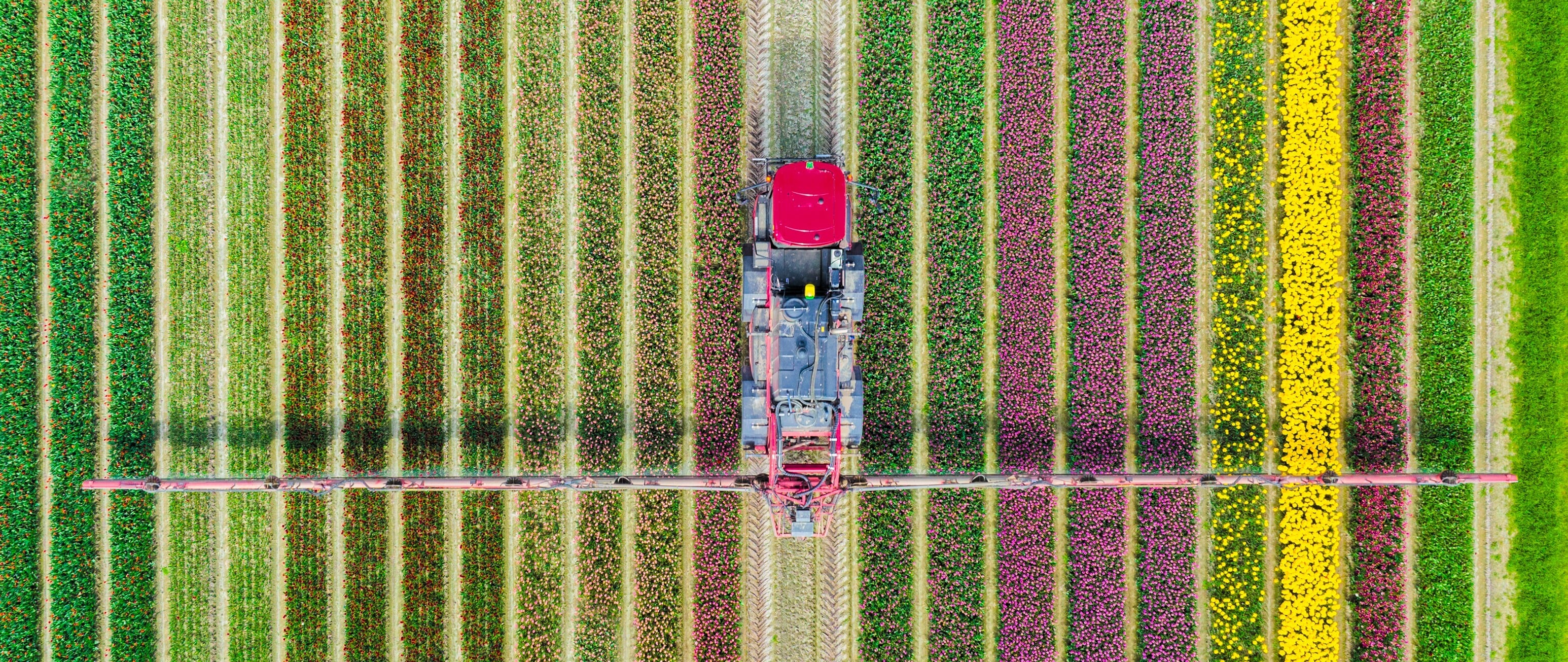
Today, roughly 50% of the world’s food production relies on ammonia-based fertilizers, meaning that around half of the world’s food supply is interdependently tied to the steady production and distribution of the natural gas feedstocks from which much of today’s ammonia is made.
So, what happens when this interdependent relationship is challenged, interrupted or strained?
Recent events such as the conflicts in the Middle East have exposed massive vulnerabilities in the global energy system and the many industries its disruption affects – and the global food system is no exception. In this context, building a diversified energy infrastructure is not only imperative for creating more resilient energy systems, but also essential in de-risking the world’s food supply.
For today’s agricultural industry, green ammonia offers a direct link between a diversified future of energy, and a more resilient global food supply.
How did ammonia become the backbone of modern agriculture?
The origins of ammonia becoming a foundation for the modern agricultural industry started in 1908, when Fritz Haber combined nitrogen from the air with hydrogen, over a metal catalyst at high pressure and temperature, to produce ammonia. This process was later scaled in 1913 by Carl Bosch, and these two innovations combined created the Haber–Bosch process – one of the most consequential chemical processes ever developed.
The Haber-Bosch process is fundamental to the rise of industrial agriculture and is essential to global food production that has scaled alongside exponential population growth. By taking nitrogen, a natural element that makes up roughly 78% of Earth’s atmosphere and stabilizing it with hydrogen made through steam methane reforming or coal gasification, the Haber-Bosch process develops a form of nitrogen (ammonia) that can be used as fertilizer. In nature, nitrogen is developed in soil through long cycles of breakdown and decomposition in organic matter and is essential for plant growth and health. By enriching soil with nitrogen-dense compounds like ammonia, synthetic fertilizers bypass the need for these longer natural processes, creating soil that enables early crop maturity and a higher density of produce for harvesting.
The ability to growth crops robustly, without crop rotation and with faster harvest cycles, changed the agricultural industry for good. The ensuing ‘green revolution’ marks a time of tremendous growth in industrial agriculture, with farmers producing roughly eight times more calories today than they did in the 1960s. While this growth can be attributed in part to a variety of factors, such as the expansion of agricultural land and the prioritization of optimized crop variants, the proliferation of ammonia-based fertilizers is a fundamental backbone of modern agriculture.
A tight and at times fragile connection between energy and food
Natural gas accounts for roughly 70-90% of ammonia’s production costs, and roughly 80% of the world’s ammonia is used to produce synthetic fertilizers. When natural gas supply and prices are disrupted, it does not take long before those shockwaves are felt in the fertilizer industry and, consequently, in the global food market.
In May of this year, the Food and Agriculture Organization of the United Nations (FAO) reported that the impacts of trade disruption in the Strait of Hormuz on global food pricing were already visible and concerning. In the first month of the conflict in Iran, urea and ammonia prices rose by roughly 50% and 20%, respectively. Over the same period, FAO Food Price Index reported three consecutive months of rising international food prices from February to April 2026.
Among the many vulnerabilities that these geopolitical events have exposed in our energy system, one of the most consequential is this link that exists between energy prices and food costs, This link, if left unchanged, exposes us to potentially devastating consequences, with the UN World Food Programme estimating that sustained high energy prices could push an additional 45 million people into acute hunger. The world’s food supply currently relies on a consistent, stably-price supply of fertilizers but continued reliance on natural gas alone leaves that stability exposed to geopolitical shocks. Diversifying the feedstocks and technologies used to produce ammonia is now a strategic priority for food security.
The resilient alternative of green ammonia
Reducing the food system's exposure to non-renewable, geopolitically concentrated energy sources – while maintaining scalable food production – is essential, and green ammonia is a key part of that solution. Green ammonia, a type of ammonia that sources its hydrogen from water using renewable energy, offers an alternative that can diversify fertilizer supply, de-link the price of ammonia away from natural gas, and crucially expand the market for where ammonia can be produced.
1. Diversification within current structures
It is essential to invest in alternatives that can be implemented in short, medium and long-term scopes. Green ammonia, while dependent on an increased renewable energy infrastructure that is out-of-scope for short term deployment, is an alternative that can be implemented into ammonia production as it exists today. The different technology required is in the electrolysers designed to split water into hydrogen and oxygen. Once this green hydrogen is acquired, it enters the same ammonia production processes as it’s conventional counterparts. This green ammonia is then directly implementable into the production of green synthetic fertilizers – ones that are just as effective and scalable in global food production as the fossil-based ones used today.
2. De-linking ammonia prices from natural gas feedstocks
By replacing the 70-90% of ammonia production costs that natural gas represents, renewable energy can offer a more stable, resilient and predictable economy for fertilizer production. It is important to note that renewable energy grids are not entirely immune from volatility or price surges, which is why continued build-out of renewable generation and electrolysis capacity is key. As that infrastructure scales, green ammonia is becoming an increasingly cost-competitive, viable alternative. However, the advantage of green ammonia over conventional ammonia comes from understanding the comparative risk of a food-system tied to a renewable resource, versus one tied to a non-renewable one. Geographically concentrated non-renewable resources like natural gas are incredibly vulnerable to systems change and geopolitical disruption. Renewable energy infrastructure, with its ability to be more widely distributed, offers a comparatively decentralized and de-risked alternative.
3. De-centralizing the ammonia market
Ammonia production is often found in areas with access to cheap natural gas, for example roughly a third of global ammonia exports originating from the Gulf region between 2023 and 2025. In an article written in the World Economic Forum (WEF), Supercritical Co-Founder and CEO Michelle You argues that simply adding more conventional production capacity doesn't solve the underlying issue: 'new production capacity will remain concentrated in regions with cheap natural gas, meaning that adding more supply does not mitigate the risk of concentration.' This is precisely why technologies that decouple ammonia production from geography matter for long-term resilience.
Complementary long-term practices
Synthetic fertilizers have enabled an unprecedented rise in global food production, and nitrogen-based fertilizers will remain essential to feeding a growing population for the foreseeable future.
Responsible nutrient management is important with an unnatural surplus of nitrogen in soil potentially leading to microbe depletion, soil degradation, nutrient imbalances and nitrogen leaching into groundwater. Alongside continued investment in ammonia production, many in the agricultural sector are also adopting complementary practices that improve nutrient efficiency and soil health – such as regenerative farming, crop rotation, organic amendments and composting, and bio-based inputs like seaweed formulations, animal manure and biochar.
Diversifying food production and soil stewardship is an essential long-term plan for creating more sustainable and robust food systems and can help farmers use nitrogen more efficiently while maintaining the yields the world depends on.
However, mitigating crisis requires scalable solutions that can be implemented in the short and medium term. For this timescale, green ammonia and accompanying renewable energy infrastructure warrants significant investment.
Final thoughts
Green ammonia offers a practical and scalable way to reduce one of the most fragile links in the global food system: its dependence on natural gas. Because ammonia-based fertilizers remain essential to feeding the world, diversifying how ammonia is produced is no longer just an energy issue, but a food security imperative. By enabling fertilizer production based on renewable power and water alongside lower-carbon routes like blue ammonia, green ammonia can help stabilize costs, expand where production is possible, and strengthen resilience against future shocks. Continued investment in green and blue ammonia technologies, and optimization of conventional methods, can play a critical role in building a more secure, sustainable and resilient global food system.
This is the third article in our Ammonia for Fertilizer series.
Read our earlier articles:
Getting from gas to grain – how are ammonia-based fertilizers made?
How Topsoe makes ammonia: A technology guide

/Half-year-statement-2026-dropdown-menu-272x204px.jpg)

.png) Topsoe Academy™ Topsoe Academy™ is your chance to tap into over 80 years of accumulated knowledge Find out more
Topsoe Academy™ Topsoe Academy™ is your chance to tap into over 80 years of accumulated knowledge Find out more Why fuel resilience matters for European defense Read
 If you’re ready to work alongside inspiring people like Hadise, Go solve at Topsoe.A place to make an impactRead