Skip to content
Contact us
    Select language

    Independent assessment of Topsoe Ammonia Cracking technology indicates a low commercialization risk profile

    Published On January 28, 2026
    Written By

    Joachim Harteg Jacobsen

    Last Reviewed On January 28, 2026
    Independent assessment of Topsoe Ammonia Cracking technology indicates a low commercialization risk profile featured image

    Despite global uncertainty, the global energy transition is proceeding, driven by decarbonization commitments and the urgent need to diminish greenhouse gas emissions. Hydrogen, both low carbon and green, has emerged as a cornerstone of the energy future, as it can help decarbonize industries that cannot be easily electrified the so-called hard-to-abate sectors.

    Despite global uncertainty, the global energy transition is proceeding, driven by decarbonization commitments and the urgent need to diminish greenhouse gas emissions. Hydrogen, both low carbon and green, has emerged as a cornerstone of the energy future, as it can help decarbonize industries that cannot be easily electrified the so-called hard-to-abate sectors. 

    Hydrogen, however, is difficult to transport and store. Its low energy density, for instance, creates a challenge when it comes to transportation from production point to the point of use. This issue has led to ammonia being recognized as the most economical carrier for hydrogen. With existing infrastructure, higher density and established safety protocols for storage and transport, ammonia offers a proven pathway to unlock hydrogen's potential at scale. 


    Ammonia's role as a carrier necessitates a critical technological capability: efficient, reliable and economically viable ammonia cracking back to hydrogen at the point of use. While ammonia synthesis (via the Haber-Bosch process) has been practiced industrially for over a century, large-scale ammonia cracking for hydrogen production represents a relatively nascent application. Large-scale ammonia cracking for other applications, however, is industrially proven by Topsoe. 


    The perceived validation gap creates a significant barrier to final investment decisions on hydrogen import terminals, particularly in regions like Europe, Japan and South Korea where demand for imported clean hydrogen is expected to grow. According to some, hydrogen carrier demand could represent approximately 10% of total ammonia consumption by 2035. Meeting this demand requires not only ammonia production capacity but also substantial investment in cracking infrastructure at import terminals and industrial clusters. 

    Bridging the validation gap

    Independent technical validation is essential to de-risk commercial deployment and unlock required capital. Unlike vendor-supplied information, independent assessments provide objective evaluation of technology readiness, validate design assumptions and offer credible risk ratings that inform investment decisions.

    FGE NexantECA, a globally recognized energy and chemicals advisory firm with five decades of experience in process technology evaluation, recently completed a comprehensive and independent appraisal of Topsoe's H2Retake ammonia cracking technology.

    Strong validation: low commercialization risk

    The FGE NexantECA appraisal concludes that within the defined scope and assumptions of the assessment, there is a low risk related to the commercialization of the integrated H2Retake design. This conclusion reflects the scope of the assessment and considers the typical challenges associated with innovative technologies and the absence of a full-scale commercial reference plant in hydrogen production service.


    The foundation rests on a critical distinction: while the integrated H2Retake system has not been demonstrated at commercial scale in hydrogen production, individual equipment items have been proven commercially at industrial scale in related applications. Topsoe has leveraged its extensive track record across ammonia synthesis, hydrogen production via steam methane reforming and large-scale ammonia cracking for heavy water production.


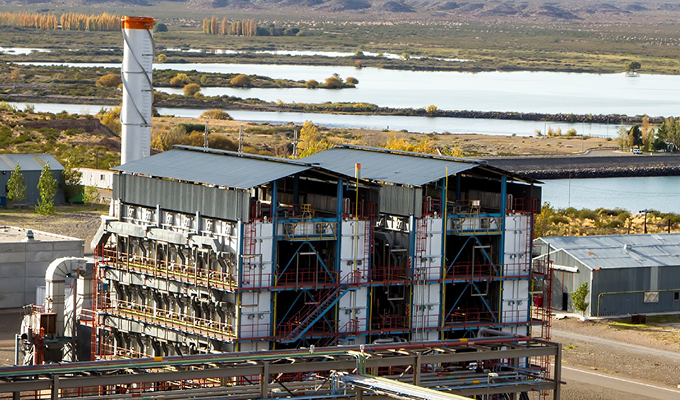
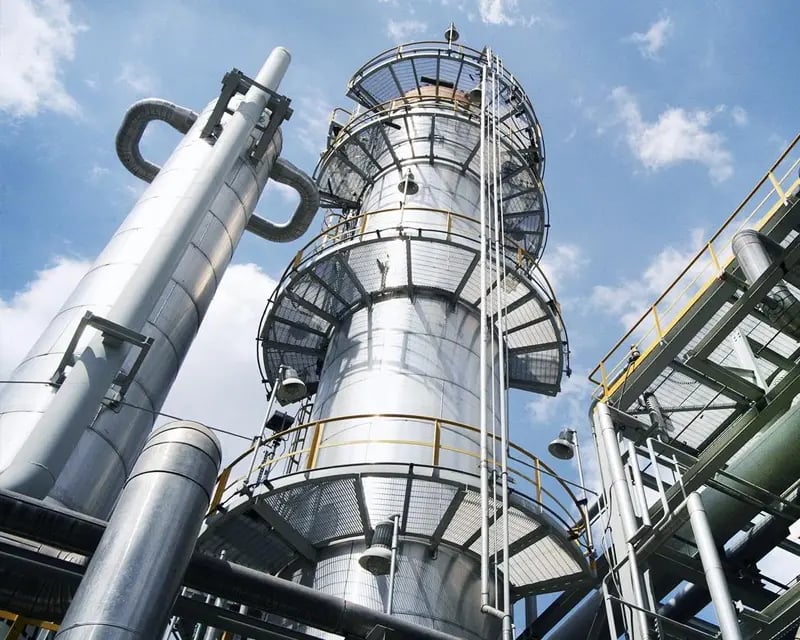
    Since 1978, Topsoe has designed and commissioned ten large-scale ammonia crackers for heavy water applications, with four units remaining in operation today, individual units exceeding 280,000 hours of operation. (see the image of the Arroyito plant in Argentina above). This extensive industrial experience provides validated data on ammonia decomposition chemistry, validated engineering design tools, catalyst behavior and long-term equipment performance. The H2Retake design incorporates decades of operational lessons–including material selection to prevent nitridation, thermal management strategies and control philosophies ensuring stable operation. At the referenced heavy water ammonia cracking facilities, performance guarantees for capacity, hydrogen purity and energy consumption were met or exceeded, demonstrating the reliability of Topsoe's design methodology.

    Systematic risk management delivers commercial confidence


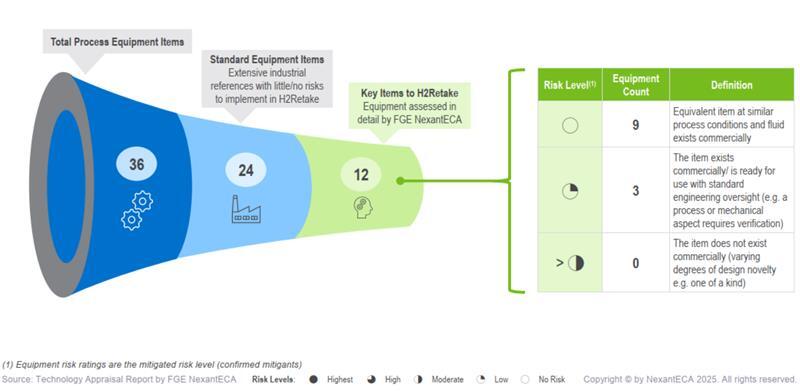
    FGE NexantECA conducted detailed risk assessments across 28 distinct risk elements of the H2Retake design. The assessment identified mitigations that reduced identified risks predominantly to 'no risk' or 'low risk' categories. Of the 28 risk items evaluated, 18 achieved 'no risk' and 10 achieved 'low risk' after implementation of all confirmed and planned mitigations – with zero items remaining at moderate, high or highest risk levels within the scope of the assessment and subject to stated assumptions. 


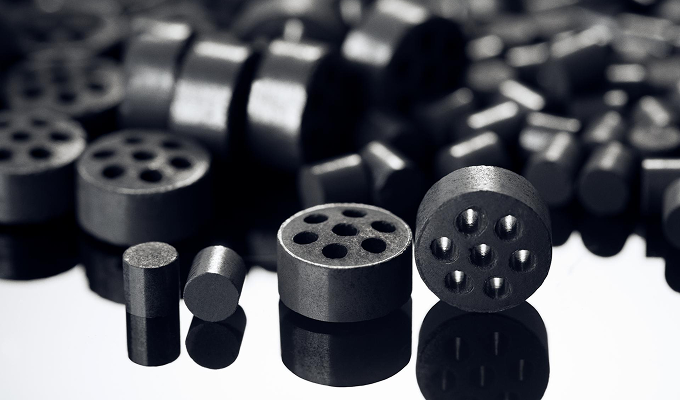
    Catalyst performance was thoroughly evaluated. Topsoe's three catalyst variants (DNK-20, DNK-30 and DNK-40) are further developed versions of commercially proven nickel-based reforming catalysts. Industrial validation in operating ammonia cracking reference plants was one of the identified mitigations still pending at the time of the risk assessment by FGE NexantECA. Topsoe has now completed subsequent industrial validation, with performance exceeding expectations and addressing the principal technical uncertainty regarding commercial-scale operation. 


    Another recommended mitigation was implementation of ammonia recovery and recycling in the process scheme to increase process robustness. These mitigations have now been fully implemented to achieve the ‘low-risk’ profile mentioned above.


    Topsoe is hopeful that this risk profile should provide increased confidence for project sponsors and lenders. Equipment items that might typically carry elevated uncertainty – including the fired ammonia cracker, critical heat exchangers, the catalyst and burner systems – received low risk ratings after implementation of all confirmed and planned mitigations. The bayonet reactor for example, has proven successful operation in reforming applications across more than 40 industrial references at more demanding conditions than H2Retake requires.


    Validated engineering tools underpin performance guarantees

    A distinguishing strength highlighted throughout the evaluation is Topsoe's proprietary process simulation capability. The General Integrated Process Simulator (GIPS) has been continuously developed since 1968 and validated against decades of operational data from industrial facilities worldwide. Unlike commercial simulation packages, GIPS incorporates empirical data, validated thermodynamic models and continuous feedback from operating plants.

    FGE NexantECA concluded that Topsoe's proprietary simulation software significantly enhances the credibility of the H2Retake design, noting Topsoe's proven record of successful transitions from simulation to commercial operation where performance guarantees were met or exceeded.

    This enhanced simulation capability underpins Topsoe's comprehensive performance guarantees including production capacity, hydrogen purity and ammonia consumption–the metrics most critical to project economics. For project sponsors and lenders, such guarantees represent a fundamental transfer of technical risk from the project to the technology provider, substantially improving the risk-return profile. 


    Accelerated path to commercial deployment

    FGE NexantECA's assessment acknowledges that H2Retake follows an accelerated commercialization pathway bypassing traditional pilot and demonstration phases. The evaluation concludes that this approach would be enabled by Topsoe's extensive industrial experience, proven component technologies and sophisticated simulation capabilities, carrying acceptable risk given the strength of confirmed mitigations and comprehensive performance guarantees.

    An accelerated pathway offers significant strategic advantages. Traditional technology development can require a decade or more. By leveraging proven components and validated engineering tools, experienced technology providers can compress development timelines while maintaining acceptable risk profiles. With industrial catalyst validation now completed and performance exceeding expectations, H2Retake has addressed the principal uncertainties that might otherwise delay commercial deployment.


    Implications for the hydrogen economy


    The positive assessment findings demonstrate that large-scale ammonia cracking can be de-risked sufficiently to support near-term investment decisions, potentially accelerating hydrogen import infrastructure development by several years compared to pathways requiring full-scale demonstration plants.


    For procurement professionals and project developers, the assessment establishes a benchmark for evaluating technologies based on independently validated risk profiles rather than vendor claims alone. For the financial community, independent validation of this caliber provides the technical due diligence necessary to support large-scale infrastructure financing.


    For the broader hydrogen economy, accelerated deployment of ammonia cracking capacity addresses a critical bottleneck. As green and blue ammonia production capacity expands globally, reliable, efficient cracking technology at import terminals and industrial clusters becomes essential to realizing hydrogen's role in industrial decarbonization.


    Moving from validation to deployment


    The energy transition demands unprecedented speed in technology deployment while maintaining rigorous standards for safety, reliability and performance. Topsoe is confident that FGE NexantECA's independent assessment demonstrates how experienced technology providers can leverage decades of industrial experience to develop new applications with manageable, well-understood risk profiles.


    The finding of low commercialization risk for an integrated system represents a significant validation milestone, supported by systematic risk assessment, proven component technologies, validated simulation tools and comprehensive performance guarantees. For professionals tasked with technology selection, project development or investment decisions, independent validation of this depth provides the confidence necessary to move decisively from planning to execution.


    The hydrogen economy will be enabled by successful deployment of proven, reliable and economically viable infrastructure at commercial scale. Technologies that demonstrate commercial readiness through independent validation–while offering comprehensive performance guarantees backed by decades of industrial experience–represent the most credible pathway to achieving the deployment scale and pace our climate commitments demand.


    The FGE NexantECA assessment of H2Retake technology concluded that, within the defined scope and assumptions of the study, Topsoe’s ammonia cracking technology carries a low commercialisation risk profile for large-scale hydrogen production.  

    Contact us

    Want to get to know us better - get in touch!

    Take a deeper look

    cover-temp-720x406

    Our solutions

    Explore our diverse range of proven solutions for transforming renewable resources into fuels and chemicals.

    cover-temp-720x406

    Knowledge and insights

    Stay ahead of the curve by continuously updating your knowledge of the latest energy trends.

    cover-temp-720x406

    Our technologies

    Delve into our different technologies for producing low-carbon and conventional fuels and chemicals as well as for ensuring clean air.

    cover-temp-720x406

    Our podcasts

    Join the conversation on renewable fuels and circular plastic with industry experts and influencers as they discuss emerging trends and best practices.

    cover-temp-720x406

    About us

    We were founded by Dr. Haldor Topsøe in 1940. Today, we are a leading global provider of technology and solutions for the energy transition.

    cta-icon-1

    Get the latest

    Keep up with the latest news and inside stories from Topsoe.

    cta-icon-2

    Join our team

    We turn challenges into opportunities. Sound like something for you? Explore our current vacancies here.

    Topsoe_People_Pictures_-_Frederiksund_Outdoor_9_1